Panda Shrimp Care: Water, Breeding and Tank Setup Guide
General information
Bold black and white bands make the Panda Shrimp one of the most recognizable dwarf shrimp in the hobby. It is not a separate species. It is a selectively bred colour line of the bee shrimp complex, usually listed as Caridina cantonensis and sometimes as Caridina logemanni. It belongs to the group hobbyists call “Taiwan Bees.”
Taiwanese breeders developed the line from Taiwan Bee stock. The usual account is that solid-black King Kong shrimp were crossed with Crystal Black Shrimp. The result kept the deep pigment of the King Kong while bringing back the banded pattern of the crystal line.
Expect these basic numbers:
- Adult length: 2–3 cm (0.8–1.2 in), with females slightly larger
- Lifespan: roughly 1.5–2 years in stable conditions
- Difficulty: intermediate to advanced
- Price: noticeably higher than Crystal Red Shrimp, especially for well-graded animals
Here is the honest part. Pandas are less forgiving than Cherry Shrimp (Neocaridina davidi). They want soft, acidic water that holds steady. Large daily swings in temperature or TDS kill them, often a few at a time and often during a molt. If you have only kept Neocaridina so far, plan on a different setup instead of moving them into your existing tank.
Appearance
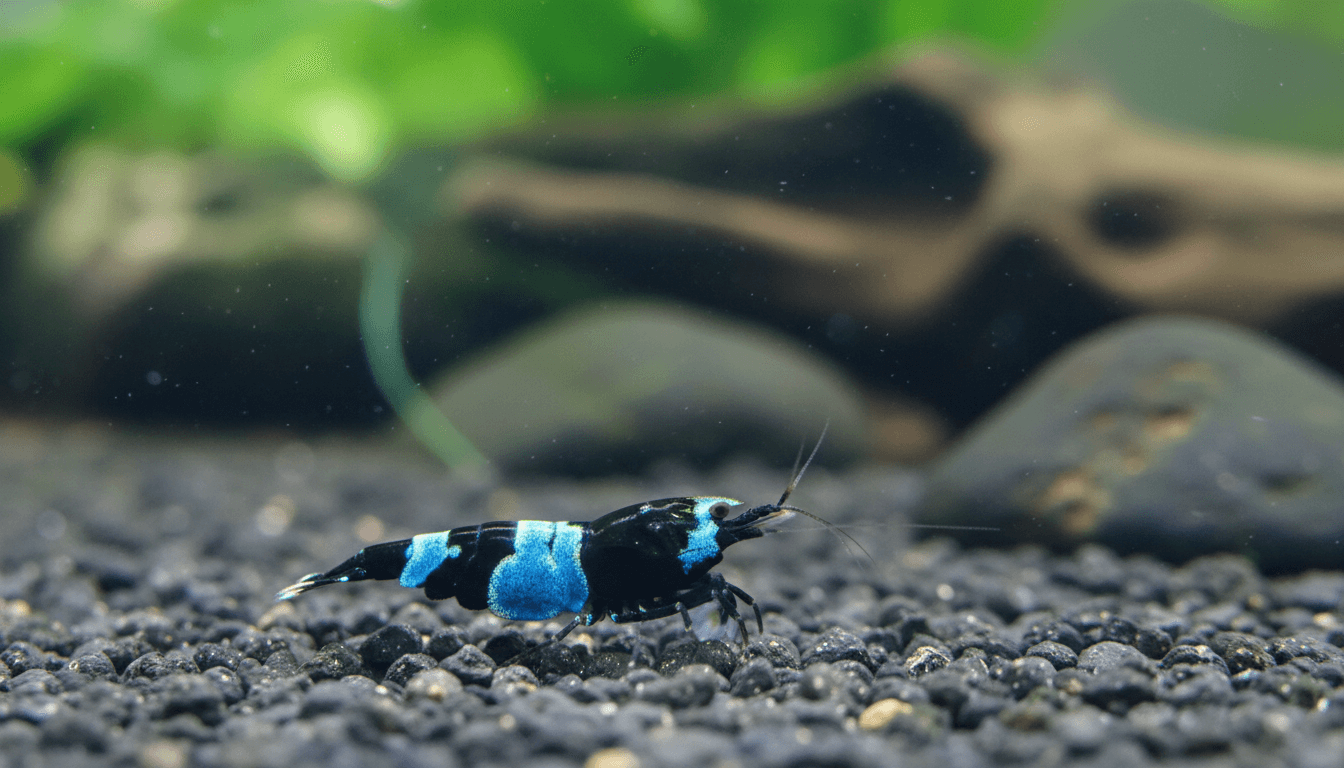
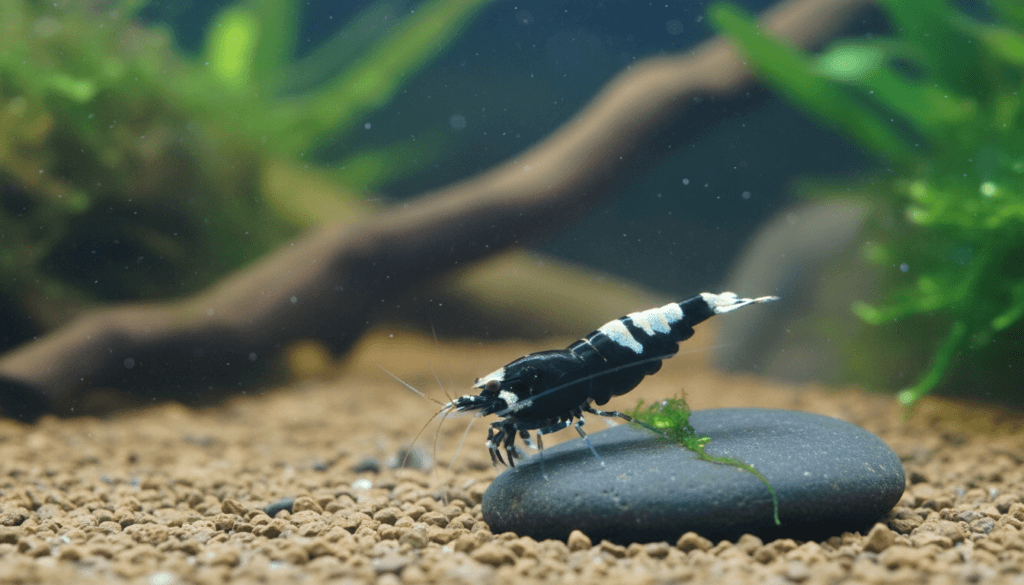
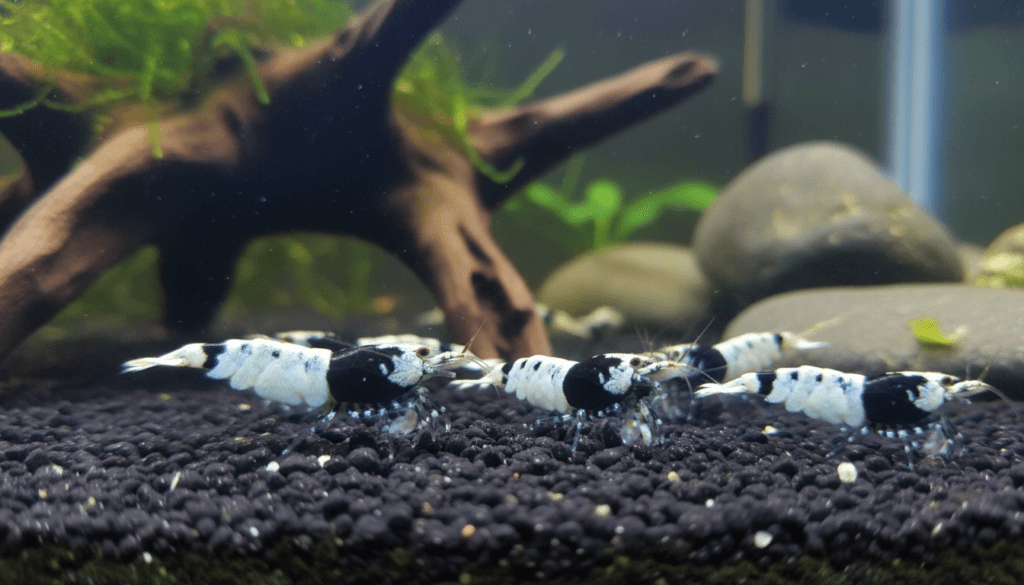
A classic Black Panda has a white head and a white rostrum area. The body behind that carries alternating rings of solid black and opaque white. Well-bred animals show clean edges between the bands with no grey smudging. The black should look deep, almost lacquered, not brownish.
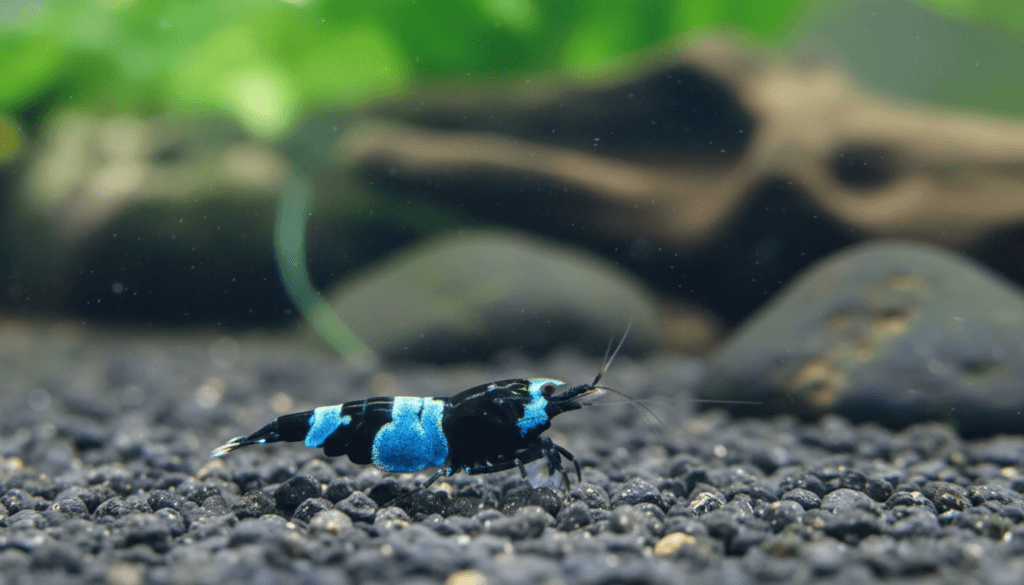
The Blue Panda swaps black for a dark navy blue. In some lines this colour shifts with water conditions and age.
When you pick out shrimp, look closely at these traits:
- Band count and width: evenly spaced bands that wrap fully around the body count as higher grade.
- White quality: dense, chalky white is preferred over a translucent or bluish white.
- Tail: a white tail fan that contrasts with the last dark band is desirable.
- Head: a clean white head without dark spots is typical of the line.
Sexing gets easier after about three months. Females have a deeper, rounded lower abdomen with a curved “saddle” under the shell where developing eggs sit. Males stay slimmer and straighter. Because the white pigment is so opaque, saddles can be harder to spot than on clear-bodied shrimp. A flashlight held behind the tank helps.
Habitat
No Panda Shrimp lives in the wild. Its ancestors do, though, and their home explains the care requirements. Wild bee shrimp come from small streams in southern China, including Guangdong and the Hong Kong area. These are shaded, cool hill streams. The water flows over gravel, stones and fallen leaves, and it carries very little dissolved mineral.
Those streams are low in hardness and slightly acidic. They stay cool for much of the year, and the bottom is coated in biofilm and decaying plant matter. Generations of captive breeding have made the line more delicate rather than tougher, so the aquarium should copy those conditions closely.
Сare and maintenance
Water parameters
Stability matters more than hitting a perfect number. A Panda colony kept at a steady pH of 6.4 will usually do better than one that swings between 5.8 and 6.6 every week.
| Parameter | Value |
|---|---|
| Temperature | 20–24 °C (68–75 °F), ideally 22 °C |
| pH | 5.8–6.8, ideally 6.0–6.5 |
| General hardness (GH) | 4–6 dGH |
| Carbonate hardness (KH) | 0–1 dKH |
| TDS | 100–160 ppm |
| Ammonia / nitrite | 0 ppm |
| Nitrate | Below 10 ppm |
Tap water rarely fits these values. The usual approach is reverse osmosis (RO) or RO/DI water remineralized with a GH-only product made for Caridina, such as Salty Shrimp Bee Shrimp Mineral GH+ or SL-Aqua Mineral. Do not use a GH/KH product. Added KH works against the buffering soil and pushes pH up.
Above 26 °C you will see more deaths and fewer berried females. In summer, a clip-on fan blowing across the water surface can drop the temperature by 2–3 °C. A TDS pen is not optional for this species.
Tank size
| Parameter | Value |
|---|---|
| Minimum volume | 20 L (5 US gal) |
| Recommended volume | 45–60 L (12–16 US gal) |
| Recommended dimensions | 45 × 30 × 30 cm or 60 × 30 × 25 cm (length × depth × height) |
Shrimp live on the bottom. Floor area counts for more than height, so a long, shallow tank beats a tall cube of the same volume. Larger volumes also hold temperature and TDS more steadily. A 20 L tank can work, but there is less margin when something goes wrong.
Filtration and water flow
An air-driven sponge filter is the standard choice. It gives gentle flow and cannot suck up shrimplets. It also grows biofilm that the shrimp graze all day. Double sponge models, like the Hikari Bacto-Surge or similar dual-head units, let you rinse one side at a time without stripping all the bacteria.
For a 60 L tank, a small canister or hang-on-back filter also works, as long as you fit a fine pre-filter sponge on the intake. Keep the flow mild to moderate. Shrimp should walk across the substrate easily, not cling to plants to stay in place. Some keepers run an undergravel filter beneath active soil, which keeps the substrate oxygenated and lets biofilm form throughout the soil layer.
Substrate and decor
Use an active, buffering soil. Popular options include ADA Amazonia, Fluval Stratum, Controsoil, Akadama and Tropica Soil. These soils pull pH down to around 6.0–6.5 and absorb carbonate hardness. Plan on 3–5 cm depth. Most soils lose their buffering power after 12–24 months, so expect to replace the substrate at some point.
New soil leaches ammonia. Cycle the tank for four to six weeks before adding Pandas, and wait until ammonia and nitrite read zero for at least a week.
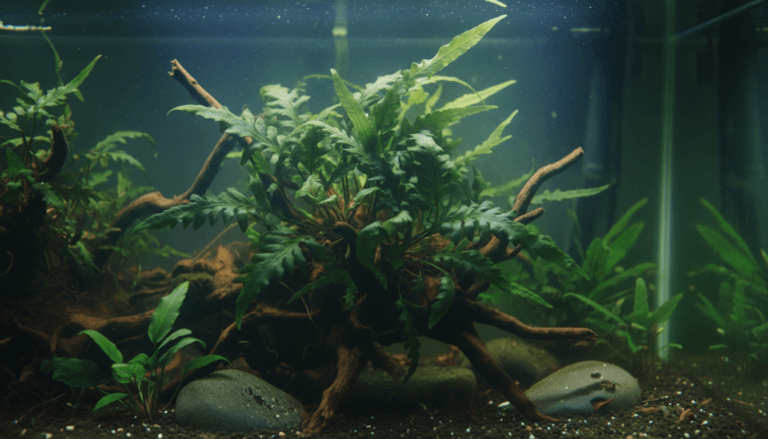
- Driftwood: spider wood or cholla wood grows biofilm fast and gives grazing surface.
- Rocks: only inert stone such as lava rock or slate. Avoid limestone, seiryu stone and anything that fizzes when vinegar touches it.
- Plants: Christmas moss (Vesicularia montagnei), Java fern (Microsorum pteropus), Bucephalandra, Anubias nana ‘Petite’ and floating Salvinia all handle soft water and low light well.
- Leaf litter: Indian almond leaves (Terminalia catappa), oak or beech leaves and alder cones add tannins and grow microfauna.
Lighting
Low to moderate light is enough. Set it for 6–8 hours a day on a timer. Strong light mostly grows algae, and these shrimp gain nothing from it. Floating plants and moss give shaded spots where molting shrimp and berried females can hide. With a dense moss carpet, you will find Pandas grazing in the open more often, since they feel safe nearby.
Water changes
Change 10% of the water once a week. Avoid big, sudden changes. A 50% swap with water at a different TDS or temperature is a common trigger for mass molting followed by deaths.
Match the new water to tank water within 10 ppm TDS and 1 °C. Add it slowly by dripping it in through airline tubing with a knot or valve, or by pouring it over a plate. Top off evaporation with plain RO water, not remineralized water. Minerals do not evaporate, so remineralized top-offs make TDS creep upward.
Social behavior and group size
Panda Shrimp are peaceful and live in loose colonies. There is no schooling and no territory. Start with at least 10 shrimp. That gives you a fair chance of getting both sexes and lets the colony spread out across the tank. Ten to fifteen animals in a 45 L setup is a good start. A healthy colony will grow to several hundred over time.
Additional behavioral care tips
Molting is the critical moment. A shrimp lying on its side after a molt, or stuck halfway out of its old shell, points to GH that is too low or water that changed too fast. Leave the old shell in the tank. The shrimp eat it to get back minerals.
Shrimp that swim frantically around the tank right after you add something new are reacting to a sudden change. Check temperature and TDS first. Then check for pollution like copper from medicines, fertilizers that contain copper or residue on your hands.
Acclimate new shrimp by drip for 2–3 hours. Pandas from breeders often come from very different water, and a fast transfer is one of the most common reasons new shrimp die in the first week.
Compatibility
A species-only tank is best. If you want tankmates, they need to tolerate soft, acidic, cool water and should be too small to eat shrimplets.
| Tankmate | Compatible? | Note |
|---|---|---|
| Crystal Red / Crystal Black Shrimp | Yes, with caution | Same water needs, but they interbreed with Pandas. Keep them apart if you want a pure line. |
| Other Taiwan Bees (King Kong, Blue Bolt) | Yes, with caution | Will hybridize. Mixed offspring often lose the clean banding. |
| Neocaridina (Cherry Shrimp) | No | No hybridizing, but Neocaridina prefer harder water and usually outcompete Pandas for food. |
| Amano Shrimp (Caridina multidentata) | Yes | Peaceful, but greedy at feeding time. Spread food around the tank. |
| Nerite snails | Yes | Good algae grazers. In soft water, offer calcium for their shells. |
| Otocinclus | Yes | Harmless to shrimp. Needs a mature tank with plenty of biofilm. |
| Chili Rasbora (Boraras brigittae) | Partly | Usually leaves adults alone, but will eat some newborn shrimplets. |
| Endler’s Livebearer | No | Prefers harder water and hunts shrimplets constantly. |
| Betta | No | Will hunt both adults and juveniles. |
| Dwarf crayfish (Cambarellus) | No | Catches freshly molted shrimp. |
Feeding the Panda Shrimp
In a mature tank, most of the diet is biofilm. That is the film of bacteria, algae and microorganisms that coats wood, leaves, moss and soil. Prepared foods add to it but do not replace it. This is why a tank that is only three weeks old cannot support Pandas, even if the test kit shows good numbers.
Feed small amounts once a day or every other day. Give only what the colony clears in about two hours. Take out leftovers after that, since uneaten food in soft, low-buffer water breaks down quickly and raises ammonia.
Good food options:
- Staple pellets: Shirakura Ebi Dama, GlasGarten Shrimp Dinner or Fluval Bug Bites for shrimp
- Biofilm powders: GlasGarten Bacter AE or a similar product, dusted lightly on the surface two to three times a week (especially valuable when you have shrimplets)
- Vegetables: blanched spinach, zucchini or kale, removed after 12–24 hours
- Leaves: dried mulberry leaves, nettle and Indian almond leaves, which shrimp graze for weeks as they soften
- Protein: a pinch of bee pollen or a shrimp-safe protein food once a week, particularly for berried females
Check every food label for copper. Many fish foods contain copper sulfate as a trace element, and copper is toxic to shrimp at very low levels.
Reproduction
Pandas breed readily once water is stable, which is the main sign that your setup is correct. Unlike Amano Shrimp, whose larvae need brackish water, bee shrimp have direct development. The young hatch as tiny copies of the adults, so no larval stage is involved and no special rearing tank is needed.
The cycle works like this. A mature female molts, and pheromones in the water draw the males. Over the next day or so you will see males swimming wildly around the tank. That is a mating dance, not stress. After mating, the female moves eggs from her saddle to her swimmerets.
- Clutch size: about 15–30 eggs
- Incubation: roughly 25–35 days at 22 °C (slower in cooler water)
- Hatchlings: about 1.5–2 mm long
- Sexual maturity: around 4–5 months
The female fans her eggs constantly to keep them oxygenated. A berried female that drops her eggs early is usually reacting to stress, very often a water change done during incubation. Keep changes small and slow while females are carrying.
Shrimplets hide in moss and soil for their first few weeks. Bacter AE, finely crushed pellets and good biofilm cover all their needs.
The offspring will not all look like their parents. Since Pandas come from crossed lines, you will see King Kong-type, banded and in-between babies. To raise the share of well-banded Pandas, move the best-patterned adults into a separate breeding tank and raise the most clean-banded young from there.
FAQ
Can Panda Shrimp live in tap water?
Only if your tap water is already soft. That means a GH of about 4–6 and a KH near zero, which is rare. Most tap water has too much carbonate hardness, and the buffering soil gets used up quickly trying to neutralize it. RO water with a GH-only mineralizer is far more reliable.
Why are my Panda Shrimp dying after a molt?
The usual causes are GH below 4, a large or fast water change, or a temperature swing. Test GH and TDS first. Then make sure you are only doing 10% changes with water matched to the tank. Failed molts, where the shrimp is still attached to its old shell, almost always point to mineral imbalance or sudden changes.
What is the difference between Panda and King Kong Shrimp?
Both are Taiwan Bee lines. The Black King Kong is solid black from head to tail, sometimes with a white face (the “King Kong Panda” or “Panda face” variant). A true Panda has a white head plus alternating black and white rings along the body.
How many Panda Shrimp should I start with?
Start with at least 10 shrimp, and buy them from one breeder if possible so all the animals come from the same water. A group of 10–15 makes it very likely you get both sexes. It also gives the colony enough genetic variety to grow steadily into a self-sustaining population within 6–12 months.