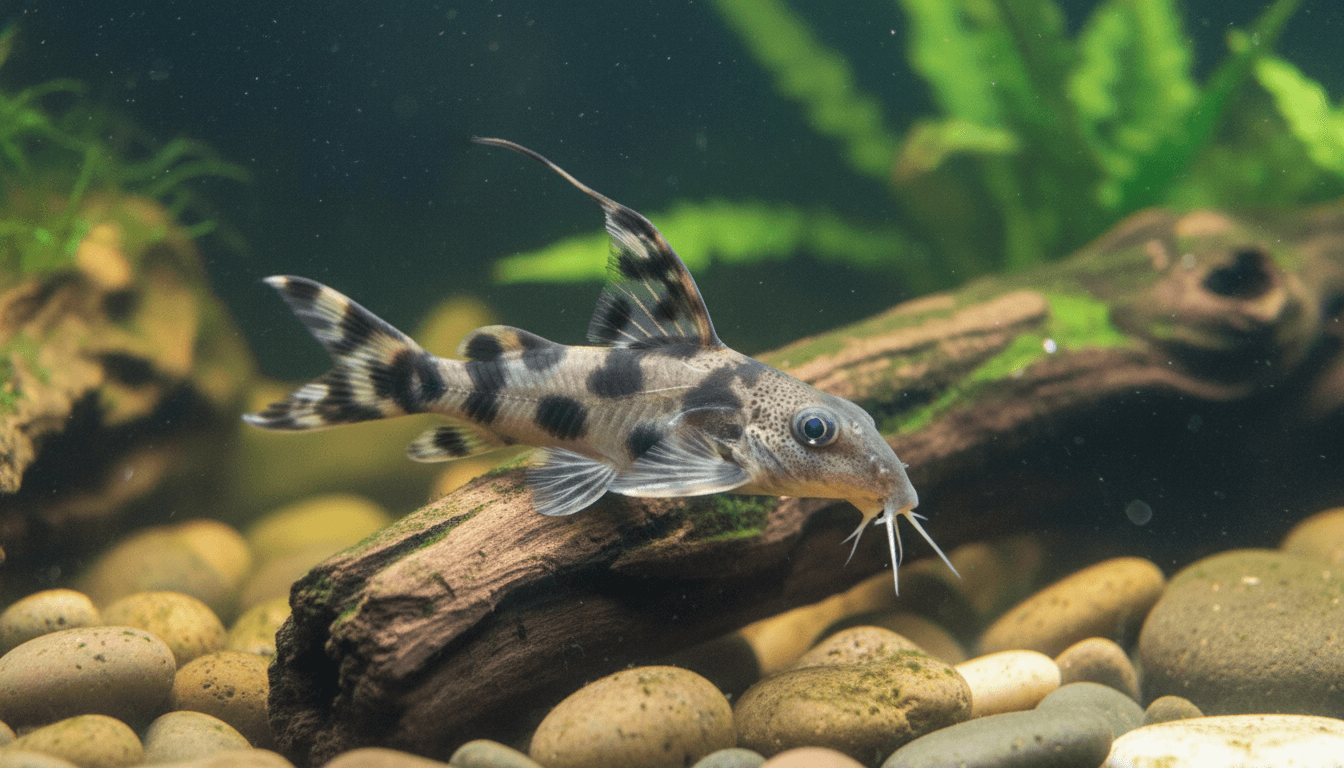
Synodontis Decorus: Complete Clarissa Catfish Care Guide
General information
Thirty centimeters. That is roughly how long a fully grown Synodontis decorus can get, and it is the first number you should know before buying the cute 5 cm juvenile in the dealer’s tank. This fish is sold as the Clarissa catfish or decorated synodontis. It belongs to the family Mochokidae, the African “squeaker” catfishes, and was described by Boulenger in 1899.
The squeaker name is literal. When you net or handle one, you may hear a faint creaking or clicking sound. The fish produces it by grinding the base of its locked pectoral spines in their sockets, a defensive trick called stridulation. It is harmless and does not mean the fish is sick.
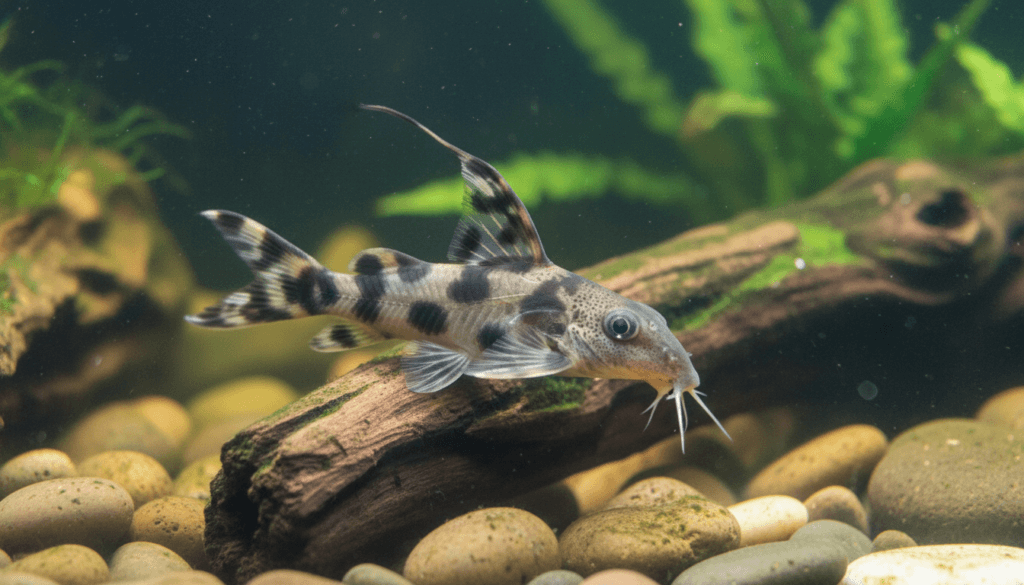
Plan for a long commitment. Large Synodontis species commonly live 15 to 20 years in good aquariums. Some individuals go beyond that. Unlike the popular Synodontis petricola, which tops out around 10–12 cm and fits a standard community tank, S. decorus is a genuinely large, heavy-bodied fish that needs an aquarium built around its adult size.
Temperament is the good news. It is peaceful toward fish it cannot swallow and spends most of the day hidden, becoming active at dusk.
Appearance
Juveniles and adults look noticeably different, so do not be surprised when your fish changes over the first couple of years.
The base color is pale gray, cream or light tan. Over it sit large, round black spots scattered across the flanks and head. Young fish tend to have fewer, bolder spots; adults often develop a denser pattern. The tail is deeply forked, and each lobe carries dark horizontal stripes that make the caudal fin look almost barred.
The feature everyone notices is the dorsal fin. In mature specimens, the first soft ray extends into a long, trailing filament that can reach well beyond the tail when the fish is swimming. Juveniles lack it or show only a short extension. Fin-nipping tankmates love to target that filament, which is a key reason to choose companions carefully.
Other identifying details:
- One pair of long maxillary barbels plus two pairs of branched, feathery mandibular barbels under the chin.
- A strong, serrated dorsal spine and pectoral spines that lock upright.
- A large, fleshy adipose fin running along much of the back.
- A hard bony shield (the humeral process) behind the gill cover.
Those locking spines matter in practice. They snag easily in nylon nets, so move the fish with a plastic container or a fine, deep net you can lift from below.
Habitat
Synodontis decorus is native to the Congo River basin in Central Africa, with records from the Democratic Republic of the Congo, the Republic of the Congo, Cameroon and the Central African Republic. It inhabits flowing sections of the main river and its larger tributaries rather than small forest streams.
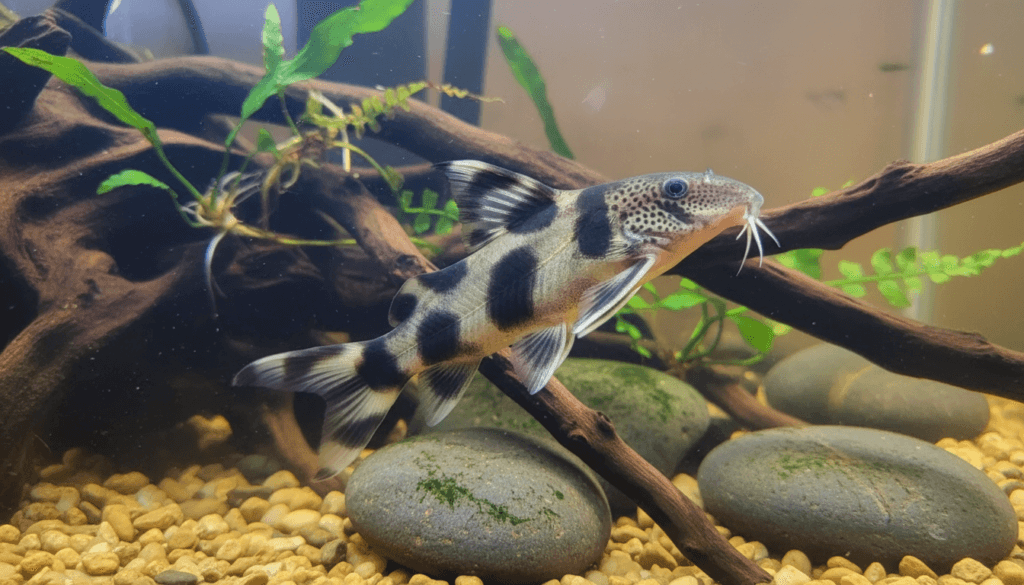
Think of wide, moderately fast water over sand and gravel, with fallen trees, root tangles and rocky ledges along the banks. The water is soft to moderately hard, slightly acidic to neutral and warm year-round. During the day, the catfish tucks itself into crevices and under submerged wood, sometimes resting upside down under an overhang. At night it forages across the bottom for insect larvae, snails, detritus and plant material.
If you want a biotope setup, pair it with other Congo species such as Phenacogrammus interruptus (Congo tetra) or larger Congo cichlids from the genus Steatocranus.
Сare and maintenance
Water parameters
This species is not fussy about exact numbers. Stability matters more than hitting a target. Keep ammonia and nitrite at 0 ppm and nitrate below 40 ppm, ideally under 20 ppm.
| Parameter | Value |
|---|---|
| Temperature | 22–27 °C (72–80 °F) |
| pH | 6.2–7.5 |
| General hardness (GH) | 4–15 dGH |
| Carbonate hardness (KH) | 2–8 dKH |
| Nitrate | Below 20–40 ppm |
Most tap water in the neutral range works without adjustment. Avoid the high-pH, very hard conditions of a Lake Malawi or Tanganyika tank; this is a river fish, not a lake one.
Tank size
Juveniles can start in a 200-liter tank, but they grow fast. Buy or plan the final tank from day one.
| Parameter | Value |
|---|---|
| Minimum volume (single adult) | 450 liters (about 120 US gallons) |
| Recommended volume (group of 3) | 600+ liters (160+ US gallons) |
| Minimum length | 150 cm (60 in) |
| Minimum front-to-back depth | 60 cm (24 in) |
| Height | 50–60 cm is enough; length and floor area matter more |
Bottom area is what counts. A tall column tank with a small footprint is a poor choice because this catfish uses the floor and lower third almost exclusively.
Filtration and water flow
A big, messy eater needs serious filtration. Use one or two canister filters rated for at least 1.5 times the tank volume, or a sump system if you are building a large tank from scratch. Aim for a total turnover of 5–8 times the tank volume per hour.
Moderate flow suits it well. Direct the spray bar or outlet along the length of the tank so there is a steady current, then leave calmer zones behind rock piles and wood where the fish can rest. A powerhead or wavemaker set on low can add river-like movement, but do not blast the bottom so hard that fine sand sprays around.
Fit a secure lid. Large Synodontis can jump when startled at night, and they will slip through gaps around filter pipes.
Substrate and decor
Choose fine, smooth sand or rounded fine gravel. Those feathery barbels are sensory organs used to taste the bottom, and sharp crushed gravel can wear them down. Pool filter sand or aquarium-grade river sand both work.
Caves are non-negotiable. Provide at least one hiding spot per fish, big enough for an adult to turn around inside:
- Large pieces of Malaysian driftwood or mopani wood arranged into overhangs.
- Stacked slate or smooth river stones glued with aquarium-safe silicone so they cannot collapse.
- Wide PVC pipes (10–15 cm diameter) or ceramic catfish caves, hidden behind rocks if you dislike the look.
Build rockwork directly on the tank glass before adding sand. Diggers can undermine stones placed on top of the substrate.
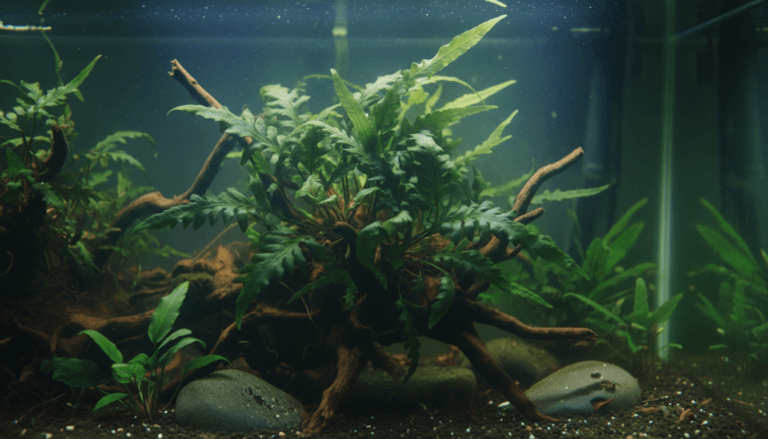
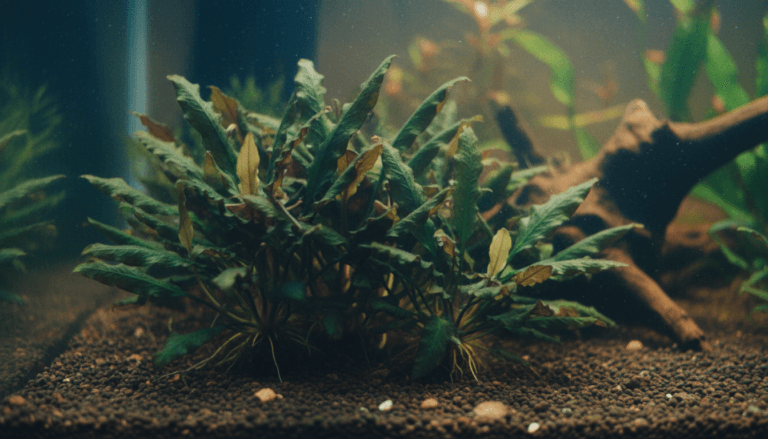
Plants are optional. Soft stem plants will be uprooted or eaten. Tough epiphytes survive: Anubias barteri var. nana, Anubias heterophylla and Java fern (Microsorum pteropus) tied to wood. Bolbitis heudelotii, an African fern, fits a Congo biotope perfectly. A thin layer of dried Indian almond or oak leaves adds tannins and foraging interest; replace them as they break down.
Lighting
Low to moderate light is ideal. Keep the photoperiod at 8–10 hours on a timer. Bright light will not harm the fish, but it will keep it hidden, so you will rarely see it.

Floating plants such as Salvinia or water lettuce (Pistia stratiotes) create dappled shade. If your filter flow is too strong for floaters, use tall driftwood and cave entrances facing the front. A dim blue or red “moonlight” LED for an hour after the main lights go off lets you watch the catfish forage.
Water changes
Change 25–30% of the water weekly. In heavily stocked tanks with several adult catfish, going to 40% weekly keeps nitrate under control. Siphon the sand surface gently in open areas, since uneaten food collects around cave entrances where you cannot see it. Match the new water’s temperature within 1–2 °C and use a dechlorinator that also neutralizes chloramine.
Social behavior and group size
You can keep this species singly. Many large Synodontis become more quarrelsome with their own kind as they age, and S. decorus is no exception. If you want a group, keep either one fish or three or more, never two, so aggression is spread out.
It is not a schooling fish. Adults establish loose territories around their favorite caves, and squabbles over the best hiding spot are normal. Expect chasing, spine-flaring and occasional grinding sounds. Actual injury is rare if every fish has its own cave and there is enough floor space. Toward other species of similar size, it is typically calm and ignores them.
Additional behavioral care tips
Upside-down swimming is normal. S. decorus sometimes grazes the underside of wood and rocks while inverted, a habit it shares with its relative Synodontis nigriventris, the famous upside-down catfish, though decorus does it less often.
- Feed after lights out so the catfish is not outcompeted by faster fish.
- New fish may hide for weeks. Resist rearranging the decor to find them; count heads at night with a flashlight instead.
- Watch the barbels. Shortened, reddened or frayed barbels usually point to dirty substrate or sharp gravel.
- Quarantine new arrivals for 3–4 weeks. Wild-caught imports are still common and may carry parasites.
- When treating illness, note that scaleless catfish can be sensitive to full doses of some medications, including copper and malachite green. Start at half dose where the product allows it.
Compatibility
The main rule: tankmates must be too large to be eaten and calm enough not to shred that long dorsal filament. At night, the catfish will swallow anything that fits in its mouth, including small tetras and shrimp.
| Tankmate | Compatible? | Note |
|---|---|---|
| Congo tetra (Phenacogrammus interruptus) | Yes | Good midwater biotope companion; adult size of 8 cm keeps them safe from larger catfish |
| African butterfly fish (Pantodon buchholzi) | Yes | Stays at the surface, never competes for bottom space |
| Large barbs such as tinfoil barb (Barbonymus schwanenfeldii) | Yes, with caution | Size matches, but very active; may nip long fins |
| Medium to large peaceful cichlids (e.g. Steatocranus casuarius, severums) | Yes | Provide separate caves to avoid squabbles over territory |
| Other large Synodontis (e.g. S. eupterus) | Yes, in large tanks | Needs extra caves; expect some competition |
| Bichirs (Polypterus senegalus) | Yes | Both bottom dwellers; tank floor must be large enough |
| Small tetras, rasboras, guppies | No | Eaten at night once the catfish reaches 15 cm or more |
| Dwarf shrimp and small snails | No | Treated as food |
| Tiger barbs (Puntigrus tetrazona) | No | Persistent fin nippers; will target the dorsal filament |
| Aggressive large cichlids (e.g. Jack Dempsey, flowerhorn) | No | Will fight the catfish for caves and can injure it |
Feeding the Synodontis Decorus
In the wild, this catfish is an omnivore with a strong lean toward invertebrates. Mimic that with a mixed menu rather than a single staple.
Base the diet on sinking pellets or wafers sized for large bottom feeders. Look for products listing fish or insect meal first and containing some plant matter, such as spirulina. Supplement 3–4 times a week with:
- Frozen bloodworms, mysis shrimp or krill (thaw first).
- Frozen or live earthworms, chopped for younger fish.
- Blanched vegetables: zucchini slices, peas without skins or spinach.
- Pieces of fresh shrimp or white fish, fed sparingly because they foul water quickly.
- Black soldier fly larvae, a good insect protein source.
Feed adults once a day, about 30 minutes after the main lights go off. Juveniles under 10 cm grow faster with two smaller meals daily. Give an amount the catfish can finish within 10–15 minutes, then remove leftovers the next morning. Overweight Synodontis develop a rounded, bloated belly; if you see this, skip one feeding day per week.
Reproduction
There are no well-documented cases of Synodontis decorus spawning in a home aquarium. Specimens in the hobby are either wild-caught or produced on fish farms, where some Synodontis species are bred using hormone injections. Without that intervention, you should not expect spawning.
Sexing adults is possible with patience. Females are usually larger and fuller-bodied when seen from above. Males have a small, pointed genital papilla just in front of the anal fin, while the female’s opening is rounder. Juveniles cannot be reliably sexed.
If you still want to attempt it, the general approach used for other egg-scattering Synodontis is a reasonable starting point: condition a group heavily on live and frozen foods, keep the temperature at 26–27 °C and then simulate a rainy season with a large water change of cooler, softer water. Eggs of related species hatch in 2–3 days, and the fry need infusoria or crushed flake at first, followed by newly hatched brine shrimp (Artemia). Any successful, documented spawn of this species would be a real contribution to the hobby.
A related oddity is worth knowing: Synodontis multipunctatus from Lake Tanganyika is a cuckoo breeder that slips its eggs among mouthbrooding cichlid eggs. S. decorus does not do this; it is a river species with no such parasitic behavior recorded.
FAQ
How big does a Synodontis decorus get in an aquarium?
Expect 20–30 cm in a well-kept tank, with some reports of individuals slightly larger. Growth is quick in the first 2–3 years, then slows down. A 5 cm juvenile can easily pass 15 cm within its first year on a rich diet.
Is the Clarissa catfish aggressive?
Not toward other species of similar size. It mostly minds its own business and hides during the day. It can be territorial toward other Synodontis over caves, and it will eat small fish at night, so “peaceful” only applies to tankmates it cannot swallow.
Why does my Synodontis catfish swim upside down?
Occasional inverted swimming is natural behavior, used to feed on the underside of wood, rocks and leaves. It is only a concern if the fish floats upside down without control, gasps at the surface or stops eating. In that case, test ammonia, nitrite and nitrate right away and check for bloating.
Can Synodontis decorus live with Congo tetras?
Yes. Adult Congo tetras reach around 8 cm, which is large enough that a well-fed decorus leaves them alone. They swim in midwater, share similar water parameters and come from the same river basin, making them one of the best choices for a Congo biotope tank.