Flame Moss Care Guide: Taxiphyllum sp. ‘Flame’
General information
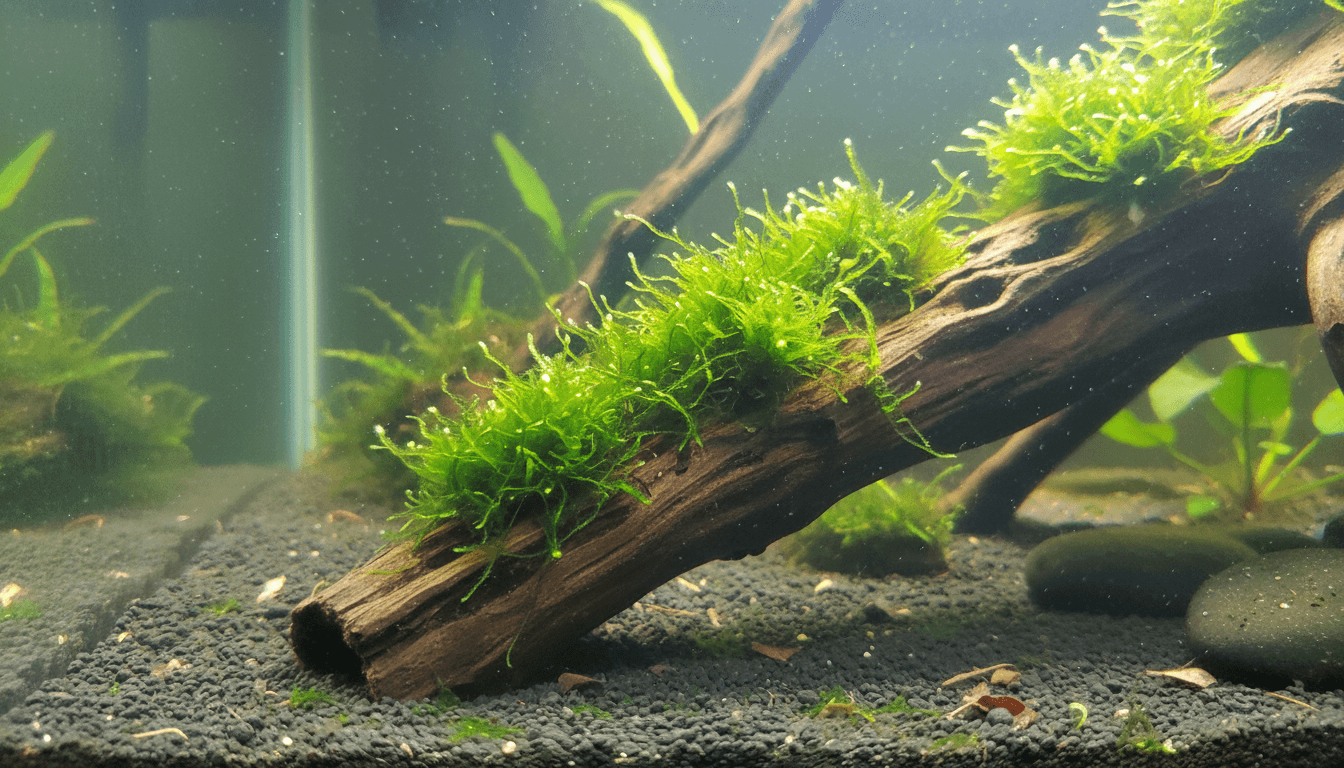
Flame Moss, scientifically labelled Taxiphyllum sp. ‘Flame’, is a popular aquarium moss prized for its upright, flame-like shoots and compact growth habit. Flame Moss establishes quickly on hardscape and forms dense, textured patches that add vertical interest without needing substrate. For those creating nano scapes or detailed midground accents, Flame Moss is a practical choice because it combines sculptural form with low long-term maintenance when set up correctly. The focus keyword Flame Moss appears here to help find this guide.
Appearance
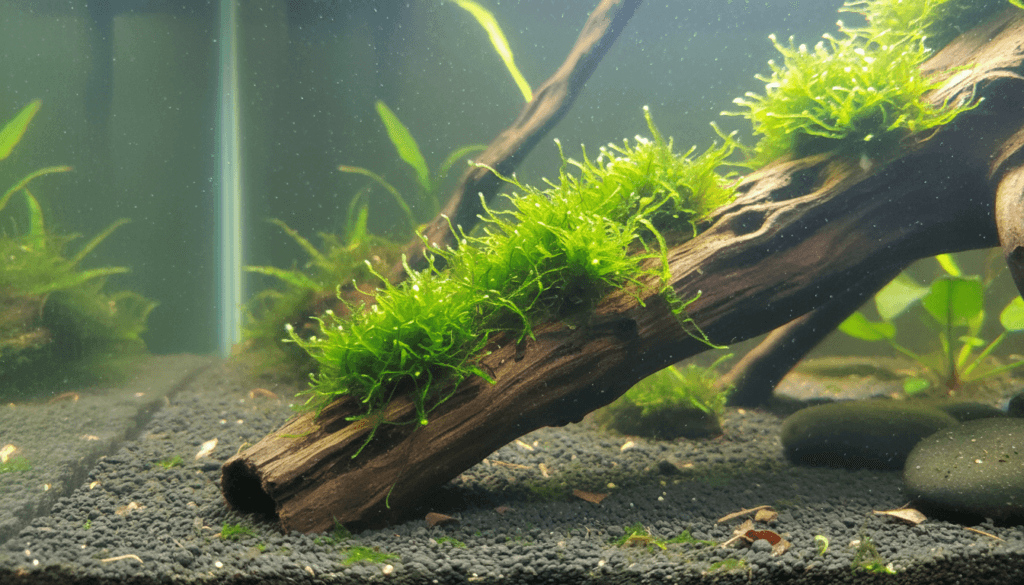
Look for short, twisted, vertical shoots that resemble tiny flames or tongues of fire. Individual shoots normally reach about 2–5 cm tall in typical aquarium conditions though older, well-lit patches can occasionally hit 6–8 cm. Leaves are tiny, overlapping, and arranged around the stem; each leaf blade is 0.5–2 mm long. Color ranges from bright leaf green under moderate to high light to deeper olive green under lower light levels. Under intense lighting and good nutrients the tips may take on a slightly yellowish-green tint.
Habitat
Flame Moss is primarily a cultivated aquarium variety of the Taxiphyllum genus rather than a well-documented wild species. It thrives attached to hard surfaces like driftwood, rock, and aquarium-safe ornaments. In nature-related setups that mimic slow-moving streams, mosses grow on stones and wood where flow brings nutrients and removes detritus without dislodging the plant. In an aquarium, stable water chemistry, gentle to moderate flow, and regular water changes reproduce those conditions.

Care and maintenance
Water parameters
| Parameter | Value |
|---|---|
| Temperature | 18–26 °C (64–79 °F) |
| pH | 6.0–7.8 |
| General Hardness (GH) | 0–12 dGH |
| Minimum tank size | 10 L / 2.5 US gallons for a small patch; 40 L / 10 US gallons recommended for visible aquascapes |
Flame Moss tolerates a wide range of temperatures and pH values but prefers stable conditions. Rapid swings in temperature or chemistry stress the moss and encourage algae.
Substrate
Flame Moss does not require nutrient substrate because it draws most nutrients directly from the water column and from surface contact with wood. When planted on rock or wood there is no need for soil. If you want a planted carpet that includes root-feeding plants, choose an aquarium soil like ADA Aqua Soil or a nutrient-rich substrate. Root tabs are unnecessary for the moss itself but can be used for nearby plants that will compete for nutrients.
Lighting
Target moderate light. Quantitatively, this means roughly 15–40 μmol·m−2·s−1 PAR at the moss surface depending on distance from the lamp and water clarity. Aim for 6–8 hours of light daily. Spectrum in the 6500 K to 7500 K range works well with planted tank LED fixtures. Too little light slows growth and causes thinning. Too much light combined with high nutrients promotes hair algae and cyanobacteria.
CO2 supplementation
CO2 is not required for Flame Moss and many successful tanks run without injection. Supplemental CO2 at low levels (<10 mg/L) speeds growth, tightens the shoot structure, and improves color under higher light. For busy aquascapes where faster growth is desired and for competitive algae control, controlled CO2 injection using a diffuser and controller is beneficial.
Fertilization
Macronutrients to consider are nitrogen (NO3), phosphorus (PO4), and potassium (K). Micronutrients include iron (Fe), manganese (Mn), copper (Cu), zinc (Zn), and trace boron. Flame Moss responds to water column dosing rather than substrate feeding.
- Standard approach: a balanced liquid fertilizer once or twice weekly following manufacturer instructions scaled to tank size.
- Low-dose method: if keeping sensitive shrimp or aiming to limit algae, dose traces (iron and micro mix) weekly and keep N and P low but detectable, around 1–5 ppm NO3 and 0.1–1 ppm PO4 depending on stocking density.
- EI-style dosing: full Estimative Index dosing can be used for aggressive aquascapes with CO2 where water changes of 30–50% weekly are performed.
When in doubt, start with a half-dose of a comprehensive fertilizer such as Seachem Flourish or Tropica Plant Growth Supplement and adjust based on algae presence and plant growth. Avoid overfertilizing in low-light tanks.
Water changes
Frequent water changes help prevent nutrient spikes and reduce algae. For most setups perform a 25–50% water change weekly. In heavily planted or high-biomass tanks leaning toward EI dosing, 50% weekly is standard. Smaller, densely stocked tanks with shrimp or sensitive species should stick to 25–30% weekly to maintain stability.
Placement in the aquarium
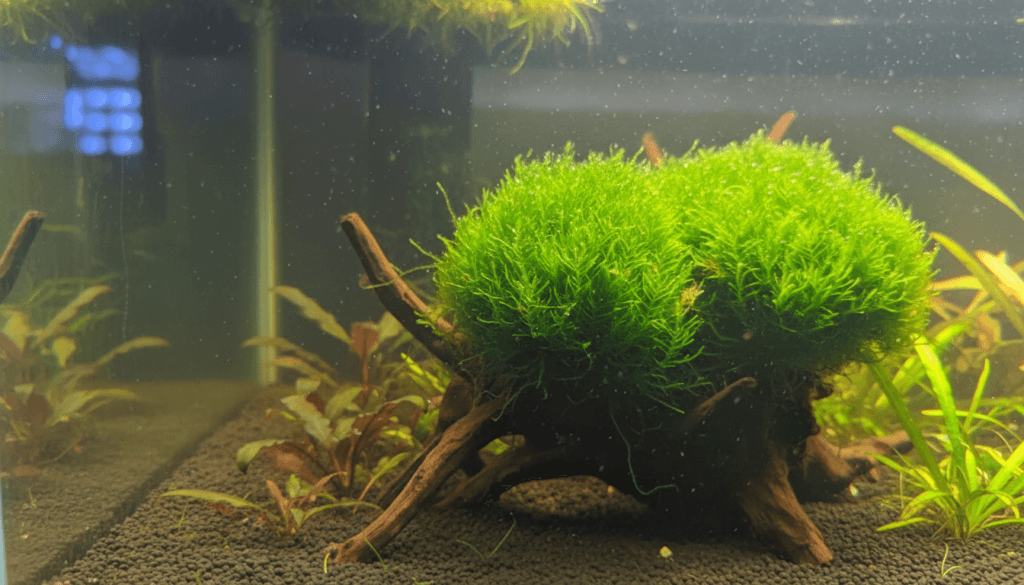
Use Flame Moss in the foreground or midground. It adds texture and volume when attached to low driftwood branches, small rocks, or as a midground accent on larger stones. Avoid the back since its height is modest and it will read better at eye level or slightly in front of taller stem plants. For nano tanks, a carpet patch in the foreground creates a natural look without requiring a true carpeting species.
Compatibility
| Tankmate | Compatible | Note |
|---|---|---|
| Neocaridina shrimp | Yes | Good for grazing biofilm and safe with moss |
| Amano (Caridina multidentata) | Yes | Excellent at removing algae from moss surfaces |
| Nerite snails | Yes | Do not reproduce in freshwater; effective biofilm grazers |
| Otocinclus | Yes | Feed mainly on soft algae and biofilm; do not eat moss |
| Common plecos | No | Large grazers will shred moss and disturb hardscape |
| Goldfish | No | Digging behavior and higher temperature preferences conflict |
| Bettas | Yes | Generally compatible; may use moss as resting spot |
| Cichlids (most) | No | Territorial digging and rearranging will displace moss |
Reproduction
Flame Moss reproduces vegetatively. New growth forms from tips and branches splitting off to create dense mats. Propagating is mechanical and straightforward. Steps:
- Trim a healthy patch into smaller clumps using scissors. Clumps of 0.5–2 cm work well for attaching.
- Attach by tying with fine cotton thread, sewing thread, or using cyanoacrylate aquarium-safe gel on rock and wood.
- Secure attachments in place for 1–3 weeks until the moss threads itself onto the surface. Flow and light influence attachment speed.
Timing: expect visible establishment within 2–6 weeks under stable conditions with moderate light. Once anchored, remove any visible ties if biodegradable thread was used or cut the thread close to the base.
FAQ
How fast does Flame Moss grow?
Growth rate depends on light, CO2, and nutrients. With moderate light and no CO2 expect steady but slow expansion—patches may double in area over several months. With CO2 and regular fertilization growth becomes noticeably faster, often doubling in 4–8 weeks.
How to attach Flame Moss to driftwood or rock?
Cut a small clump and place it on the surface. Hold it with cotton thread, clear sewing thread, or apply a pea-sized amount of aquarium-safe cyanoacrylate gel. Small plastic mesh or fishing line also works. Keep the moss secured until new growth anchors it—usually 2–6 weeks. Remove ties if they do not dissolve.
Will fish or snails eat Flame Moss?
Most fish do not “eat” moss; rather some species uproot or graze it. Shrimp and nerite snails clean biofilm without damaging living moss. Grazers like goldfish and large plecostomus can shred the moss physically when rummaging for food.
Does Flame Moss require CO2?
CO2 is optional. It accelerates growth and improves appearance under higher light but is not necessary for maintaining healthy Flame Moss in a low to moderate light setup.
How to stop algae growing on Flame Moss?
Tackle the underlying cause. Reduce light duration or intensity, ensure proper water circulation to prevent dead zones, keep nitrates and phosphates in balance, and add algae grazers like Amano shrimp. Manually remove filamentous algae using tweezers or a soft toothbrush. If algae persists, perform larger water changes and adjust fertilization.
Can Flame Moss be used in nano aquariums?
Yes. Flame Moss is excellent in nano tanks due to its compact size and the fact it can be attached to miniature hardscape elements. Keep tankmates small and avoid species known to dig or graze heavily.
What common problems affect Flame Moss?
Thin, shredding, or brown patches indicate low light, insufficient flow, poor water quality, or physical damage. Hair algae and cyanobacteria can overgrow dense moss if nutrients and light are out of balance. Regular trimming, moderate light, and stable water parameters reduce problems.
Best practical tips for success
- Attach small, flat clumps rather than large, bulky pieces to help the moss make full contact with the surface.
- Keep gentle to moderate flow across moss patches to carry nutrients and prevent detritus settling inside the mat.
- Trim the moss to shape using sharp scissors to encourage denser growth and to remove brown tips or algae-covered sections.
- Use shrimp like Amano or Neocaridina as living cleaners to reduce biofilm and soft algae without harming the moss.
- If algae invades, reduce light by 1–2 hours and perform a 30–50% water change to lower nutrients quickly.