Turquoise Discus Care: Tank, Water and Breeding
General information
The turquoise discus has no wild population. It is a line-bred color form of Symphysodon aequifasciatus (some taxonomists now split the blue and green wild forms into S. aequifasciatus and S. haraldi). Breeders created it by selecting wild blue and green discus that carried the most iridescent body striations. Jack Wattley in the United States and Eduard Schmidt-Focke in Germany did much of the early work in the 1960s and 1970s. Their fish became the foundation for almost every turquoise, cobalt and solid blue strain sold today.
You are buying a South American cichlid that behaves nothing like the rough, digging cichlids from Africa or Central America. Discus are slow and shy. They are also very sensitive to water quality. They live 10 to 15 years with good care, so a purchase is a long commitment.
Price varies enormously. A 5 cm juvenile from a local store might cost a fraction of what a 12 cm adult from a named breeder commands. The difference usually reflects growth history. It rarely reflects the color alone.
Appearance
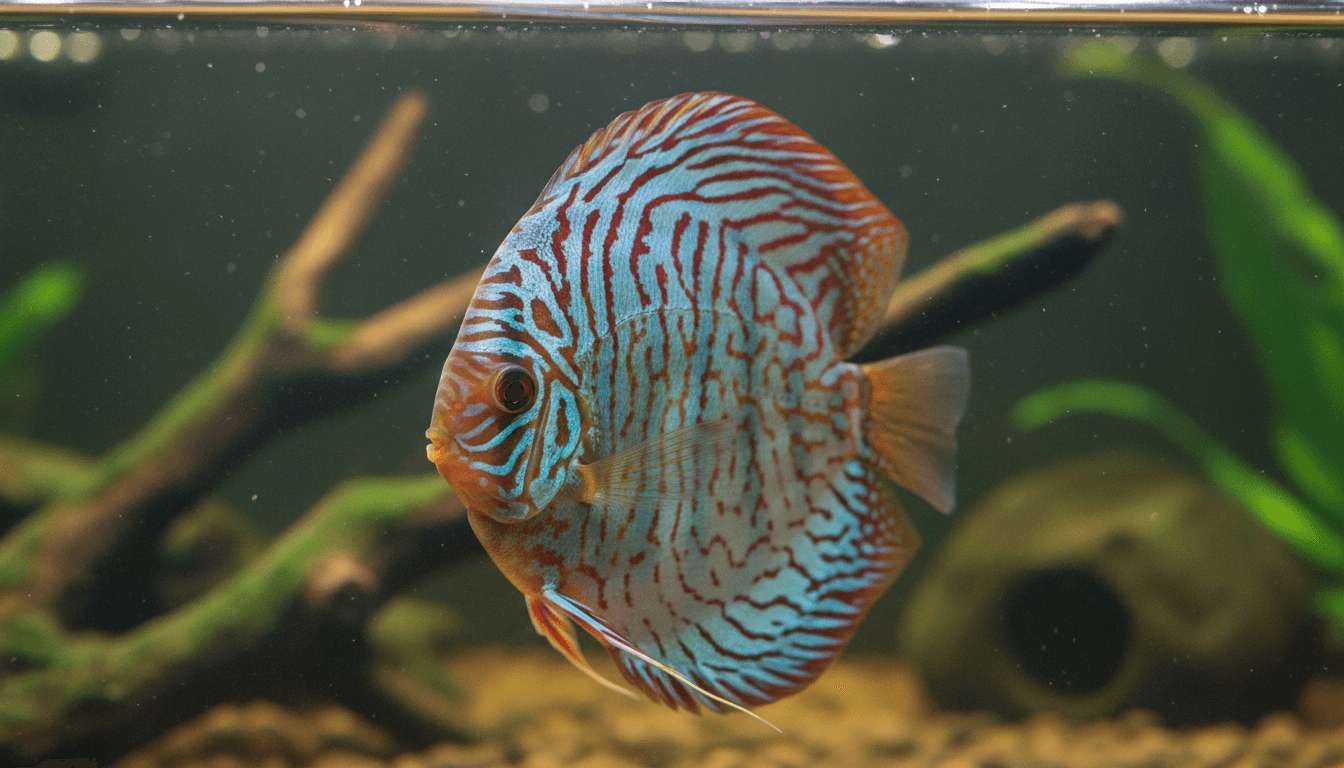
Look for a nearly circular, laterally compressed body. In top-grade adults the height roughly matches the length. Adults reach 15 to 20 cm (6 to 8 inches) in diameter, and females tend to stay slightly smaller.
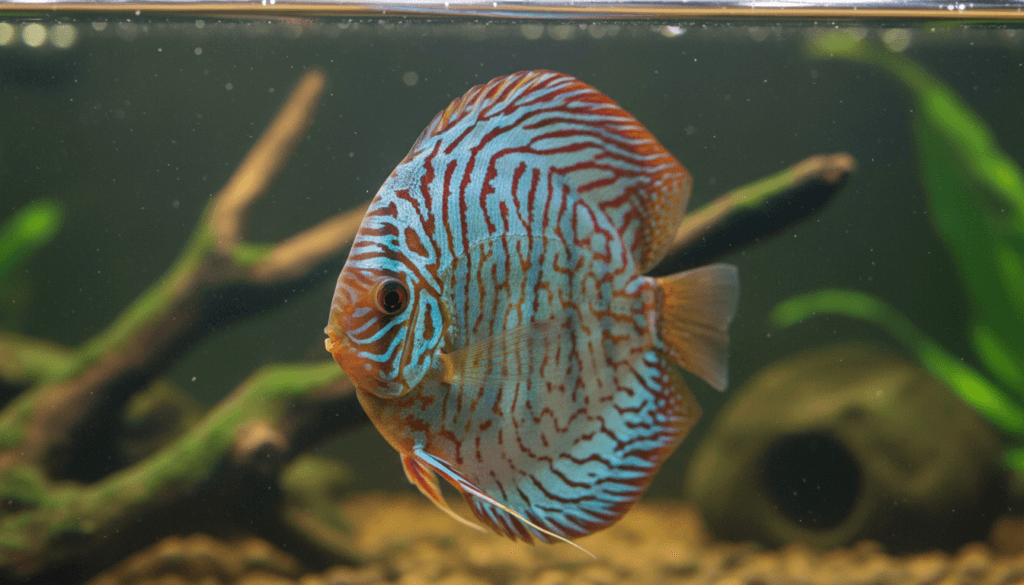
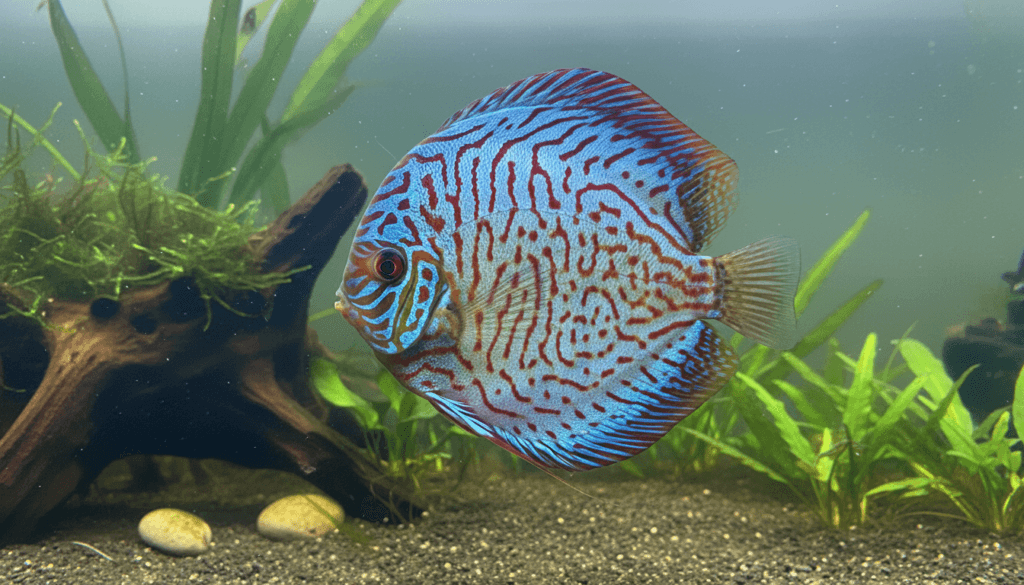
The color pattern is what defines the strain. A red-brown base sits under dense, wavy blue-green lines that run horizontally across the body and extend into the dorsal and anal fins. In “solid” or “high-body” turquoise lines, the lines merge until the red almost disappears. “Striated” turquoise keep a clear red-and-turquoise zigzag. Nine vertical dark bars may appear and fade with mood. Stressed or sick fish darken them sharply, and calm, healthy fish show them faintly.
Check the eyes. A bright red iris is typical of good stock. Eyes that look oversized compared with the body are the classic sign of a stunted fish, one kept in poor conditions while young. That fish will never reach full size.
Habitat
Since the strain was bred in captivity, its “habitat” is really the habitat of its ancestors. Wild blue and green discus come from the Amazon basin. They live in quiet lateral waters such as flooded forests, oxbow lakes and the slow edges of tributaries like the Rio Purus and the Lago Tefé region.
These waters are warm, soft and often acidic. The fish shelter among fallen branches and submerged roots, and they disperse during the high-water season. When levels drop, they crowd into the remaining tangles of wood. The water is tinted by tannins, and the bottom is covered in decaying leaves.

Generations of tank breeding have made turquoise strains a little more tolerant than wild fish. They still prefer the same warmth and stability.
Сare and maintenance
Water parameters
Heat is the non-negotiable part. Discus need warmer water than nearly every other community fish, and that one fact limits your choice of plants and tankmates more than anything else.
| Parameter | Value |
|---|---|
| Temperature | 28–31 °C (82–88 °F); 30–31 °C for breeding and juvenile growth |
| pH | 6.0–7.0 (5.5–6.5 for spawning) |
| General hardness (GH) | 1–8 dGH |
| Ammonia / Nitrite | 0 ppm |
| Nitrate | Below 20 ppm, ideally under 10 ppm |
Domestic turquoise raised in tap water often do fine at pH 7.2 and moderate hardness. A stable pH of 7.2 is far safer than one that swings between 6.0 and 7.0 because you keep adding acid buffers. Ask the seller what water the fish were raised in, and match it first.
Tank size
| Parameter | Value |
|---|---|
| Minimum volume (group of 5–6) | 250 liters (about 65 US gallons) |
| Recommended volume | 300–400 liters (80–105 US gallons) |
| Minimum water height | 50 cm (20 inches) |
| Recommended dimensions (L × H) | 120–150 cm × 50–60 cm (48–60 × 20–24 inches) |
| Space guideline | Roughly 40–50 liters (10–13 gallons) per adult |
Height matters with this body shape. A standard long-and-low tank can leave a 20 cm adult with barely a few centimeters of clearance once substrate and decor are in. Choose a tall tank.
Filtration and water flow
Aim for strong biological filtration with gentle output. A canister filter rated for 4 to 5 times the tank volume per hour works well if you spread the return with a spray bar pointed at the glass. Many breeders simply run two large air-driven sponge filters in bare tanks. The sponges also collect food particles that juveniles pick at.
Discus struggle against strong currents. If you see them hovering behind decor or pushed into a corner, reduce the flow. For a display tank, a canister plus one sponge filter gives you a backup colony of bacteria when the canister is being cleaned.
Substrate and decor
Two approaches work, and they suit different goals.
- Bare bottom: the standard for growing juveniles and for breeding. Waste is visible and easy to siphon. A dark background and a sheet of dark vinyl under the tank reduce skittishness.
- Planted display: fine sand 2–3 cm deep, so leftover food cannot sink into gaps between coarse gravel.
Vertical driftwood roots or branches mimic flooded forest cover and give the fish somewhere to retreat. Skip limestone and crushed coral, which raise hardness. Inert slate or smooth river rock is safe.
Plants have to cope with 29–30 °C. Reliable choices include Amazon sword (Echinodorus grisebachii ‘Bleherae’), Anubias barteri, Java fern (Microsorum pteropus), Cryptocoryne wendtii and Vallisneria spiralis. Carpeting species and most delicate stem plants tend to melt at these temperatures. A few Indian almond leaves (Terminalia catappa) add tannins and a mild antibacterial effect. Remove them before they break down completely.
Lighting
Keep the light moderate. Discus come from shaded, tea-colored water, and a tank lit for high-tech plants will make them hide. Run the lights 8 to 10 hours a day on a timer. Floating plants can offer patches of shade. Red root floater (Phyllanthus fluitans) or Amazon frogbit (Limnobium laevigatum) both work. Turquoise coloration shows best under full-spectrum LEDs with a slightly cool tone. Warm, yellow-heavy lighting dulls the blue-green lines.
Turn on a dim room light a few minutes before the tank light. A sudden switch from darkness to full brightness triggers panic dashes into the glass.
Water changes
This is where most discus fail. Adults in a planted display need 30–50% weekly at minimum. Growing juveniles eating five meals a day need 50–90% daily, or at least every other day, to keep growth hormones and nitrate from building up.
Match the new water’s temperature within 1 °C, and treat it with a dechlorinator that also neutralizes chloramine. If you use RO water, remineralize it to your target GH before it goes in. Pure RO water has no buffering capacity and can crash pH overnight. Aging water in a separate barrel with a heater and airstone for 24 hours makes large changes much safer.
Social behavior and group size
Keep at least five or six. Discus are shoaling cichlids with a clear pecking order. In a trio or quartet, the dominant fish tends to pick on the weakest one until it stops eating. With six or more, aggression spreads out.
Social structure is loose rather than tight schooling. The group stays in the same area, but each fish holds a little personal space. The top fish usually claims the best feeding spot. Once a pair forms, they defend a spawning site and will chase everyone else away from it, sometimes hard. If that happens in a community tank, move the pair to their own tank.
Additional behavioral care tips
- Watch for a fish hiding in a corner, with dark bars and clamped fins. That is the earliest warning of bullying or illness, often a day or two before appetite drops.
- Buy all your discus at the same time and the same size. Adding one newcomer to an established group invites attacks.
- Quarantine new fish for 4–6 weeks. Discus carry pathogens that other discus strains may have no resistance to.
- White, stringy feces and a darkened fish that refuses food point to Hexamita or other intestinal flagellates. Metronidazole is the usual treatment.
- Place the tank away from doors and heavy foot traffic. Constant movement next to the glass keeps discus nervous.
Compatibility
Every tankmate has to handle 29–30 °C for years without shortening its life. It also cannot be quick enough to steal all the food from slow-feeding discus. Those two filters eliminate most “peaceful community fish.”
| Tankmate | Compatible? | Note |
|---|---|---|
| Cardinal tetra (Paracheirodon axelrodi) | Yes | Tolerates heat well; add as adults so they aren’t eaten |
| Rummy-nose tetra (Hemigrammus bleheri) | Yes | Heat tolerant; tight schooling looks great under discus |
| Sterba’s cory (Corydoras sterbai) | Yes | One of the few corys comfortable above 28 °C; needs sand |
| Bristlenose pleco (Ancistrus sp.) | Yes, with care | Provide wood and algae wafers; rare cases of rasping sleeping discus |
| German blue ram (Mikrogeophagus ramirezi) | Yes | Needs similar warmth; keep only one pair |
| Neon tetra (Paracheirodon innesi) | Not recommended | Prefers cooler water; lifespan drops at discus temperatures |
| Angelfish (Pterophyllum scalare) | No | Competes for food; known to transmit diseases to discus |
| Common pleco (Pterygoplichthys sp.) | No | Grows huge; may latch onto discus and eat their slime coat |
| Tiger barb (Puntigrus tetrazona) | No | Fin nipper; too fast at feeding time |
| Cherry shrimp (Neocaridina davidi) | No | Short-lived at 30 °C and will be eaten |
A species-only tank is the easiest route for beginners with discus. It removes competition and disease risk entirely.
Feeding the Turquoise Discus
How often? Juveniles under 10 cm need 4–6 small meals a day. That growth window closes around 12 months, and a fish underfed during it stays small for life. Adults do well on 2–3 meals a day.
Build the diet around variety:
- Beefheart mix: the traditional growth food. Lean beef heart blended with shrimp, spinach, garlic and vitamins, then frozen flat. It fouls water fast, so siphon leftovers after 5 minutes.
- Frozen foods: mysis shrimp, adult brine shrimp and blackworms. Buy bloodworms from gamma-irradiated brands, as wild-harvested ones can carry parasites.
- Dedicated granules: slow-sinking discus granules such as Sera Discus Granules or Tetra Discus. Soak them for a minute first so they sink slowly.
- Flakes and freeze-dried foods: useful as a supplement. Freeze-dried blackworm cubes pressed against the glass teach shy fish to feed at the front.
Avoid live tubifex from ponds. It was once standard in discus keeping and is also a common route for bacterial infections. A fish that suddenly refuses its favorite food for two days in a row is sick until proven otherwise. Check parameters, then look closely at its feces.
Reproduction
Pairs form on their own. You cannot reliably sex discus by looking at them outside spawning. Grow a group of six to eight together and let a pair choose each other. You will see two fish claim a vertical surface, shake and bow at each other, and clean it with their mouths.
Move the pair to a breeding tank of 100–150 liters with a bare bottom, a sponge filter and a spawning cone or an upturned terracotta pot. Soft, acidic water triggers spawning: pH 5.5–6.5, conductivity under 200 µS/cm and a temperature of 29–31 °C. A large water change with slightly cooler RO water often starts courtship within days.
- The female lays 100–300 eggs in lines on the cone. The male follows and fertilizes them.
- Both parents fan the eggs and remove any that turn white with fungus.
- Larvae hatch after about 50–60 hours. The parents may move them to a new spot.
- Around days 5–6 the fry become free-swimming and swim straight to the parents’ flanks.
Here is the counterintuitive part. Unlike almost any other aquarium fish, discus fry feed on a mucus secreted from their parents’ skin for the first week or more. Both parents produce it, and they pass the swarm between them. From about day 5 you can offer newly hatched Artemia nauplii several times a day. Separate the fry at 3–4 weeks. By then they are eating on their own, and the parents’ skin is getting damaged.
Young pairs often eat their first few clutches. Leave them alone, feed them well and keep the tank quiet. Most pairs learn by the third or fourth spawn. If they never stop eating eggs, a mesh cone cover protects the eggs while still letting the parents fan them.
FAQ
Are turquoise discus good for beginners?
They are not ideal as a first fish. They are manageable, though, if you already keep a stable tropical tank and commit to large weekly water changes. Start with adults of 10–12 cm from a reputable breeder. Juveniles demand far more feeding and water changing.
How many turquoise discus can I put in a 55 gallon tank?
A 55 gallon (about 210 liter) tank is at the lower limit. Five adults is the realistic maximum, with no large tankmates. Its standard 21-inch height is fine. A 75 gallon or larger tank gives a six-fish group more room and more stable water.
Why is my discus turning dark and hiding?
Darkening is a stress signal. The common causes are bullying from a dominant fish, rising nitrate, a drop in temperature and internal parasites. Test the water first. Then watch feeding. If the fish refuses food and produces white feces, treat for flagellates.
Can turquoise discus live in tap water?
Usually, yes. Most farm-raised turquoise are bred in water up to pH 7.5 and moderate hardness. The key is consistency: dechlorinate, match the temperature and keep parameters steady. For breeding, you will likely need to soften the water with RO.