Apistogramma Trifasciata: Care, Tank Setup & Tips
General information
Apistogramma trifasciata is a South American dwarf cichlid that fits neatly into planted, biotope-style tanks and nano setups when a calm temperament is desired. This species is smaller than many central American cichlids, reaching roughly 6–7 cm (2.5–3 in) total length, and displays the classic Apistogramma combination of territorial males and brood-caring females. The focus keyword appears naturally here: Apistogramma trifasciata thrives in softer, slightly acidic water and a decor that provides caves and leaf litter.
If a subtle, region-accurate appearance and active, watchable behavior are goals, this species is a candidate. It is not a heavy-bodied show cichlid, but it rewards careful keepers with interesting courtship and parental care. Practical choices—tank dimensions, filtration type, and diet—determine success more than flashy ornamentation.
Appearance
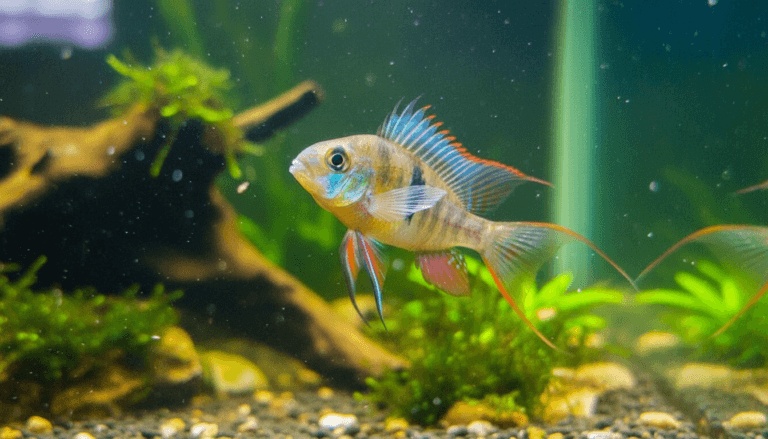
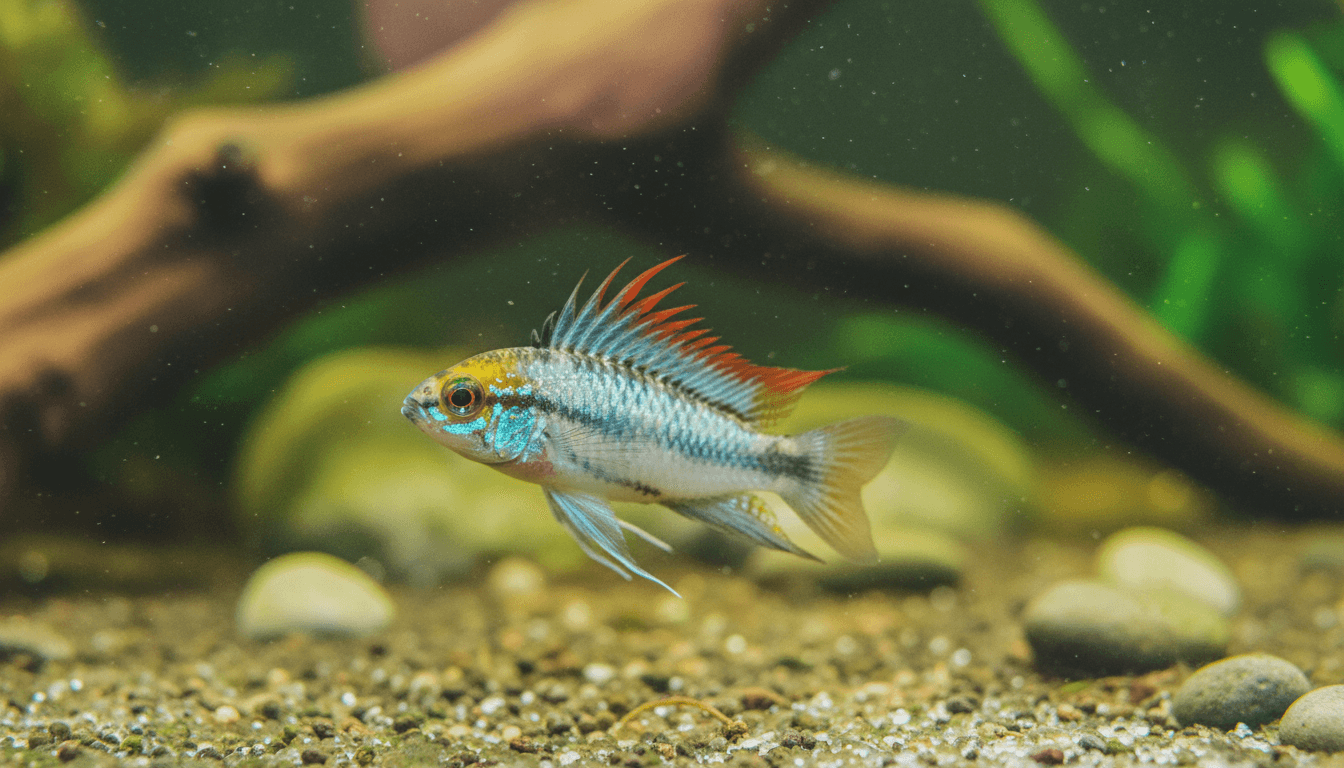
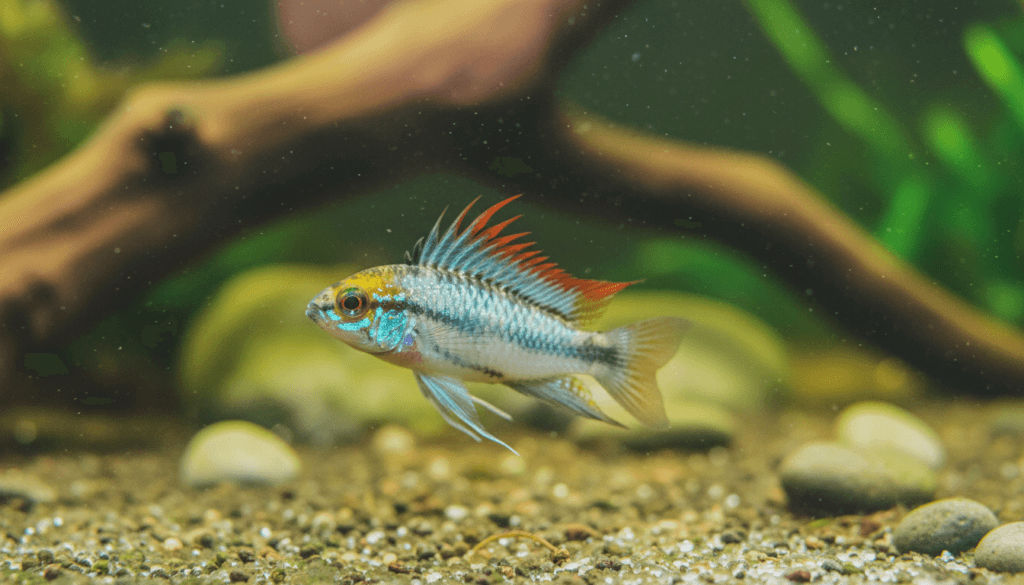
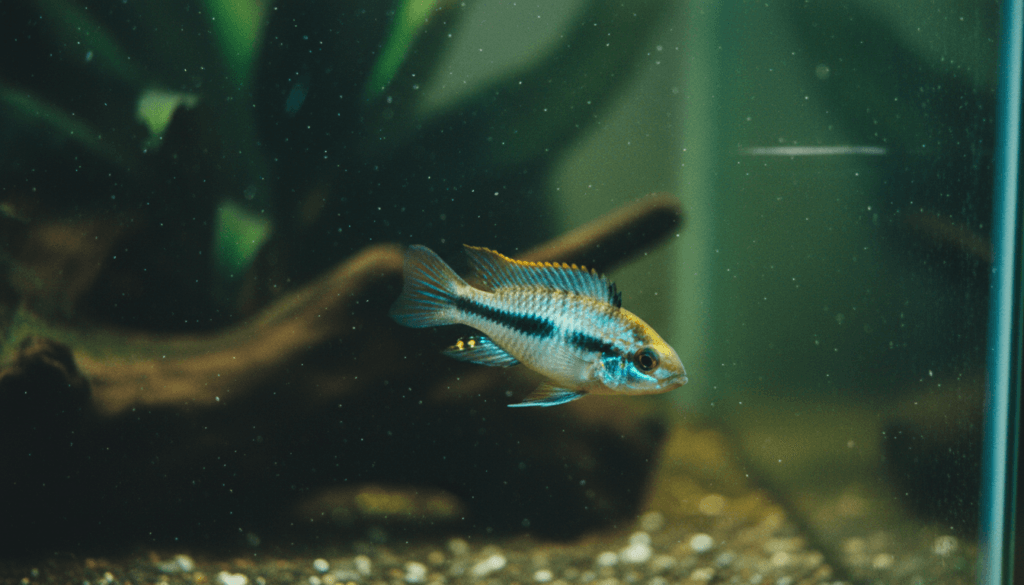
Coloration depends on sex and mood. Males typically show stronger vertical bars, a clearer lateral stripe, and elongated dorsal and caudal fin extensions. Females are smaller, often with warmer orange or red tones on the throat and belly when gravid. Both sexes have three noticeable vertical bands across the body—this is part of what gives the species its name and makes individual identification straightforward in a community tank.
Body shape is laterally compressed with a modest forehead slope. Juveniles are paler and harder to sex reliably until fins and color deepen at about 3–4 months old. Expect subtle seasonal or condition-related color shifts: richer pigment during breeding conditioning and paler tones after stress or illness.
Habitat
Native waters tend to be slow-moving blackwater or tannin-stained tributaries with soft substrates, submerged wood, leaf litter, and dense marginal vegetation. In nature, water has warm temperatures, low mineral content, and a brown tea-like color from tannins. Recreating parts of that environment—caves, shaded zones, and decomposing leaves—helps reduce stress and encourage natural behaviors such as cave spawning.
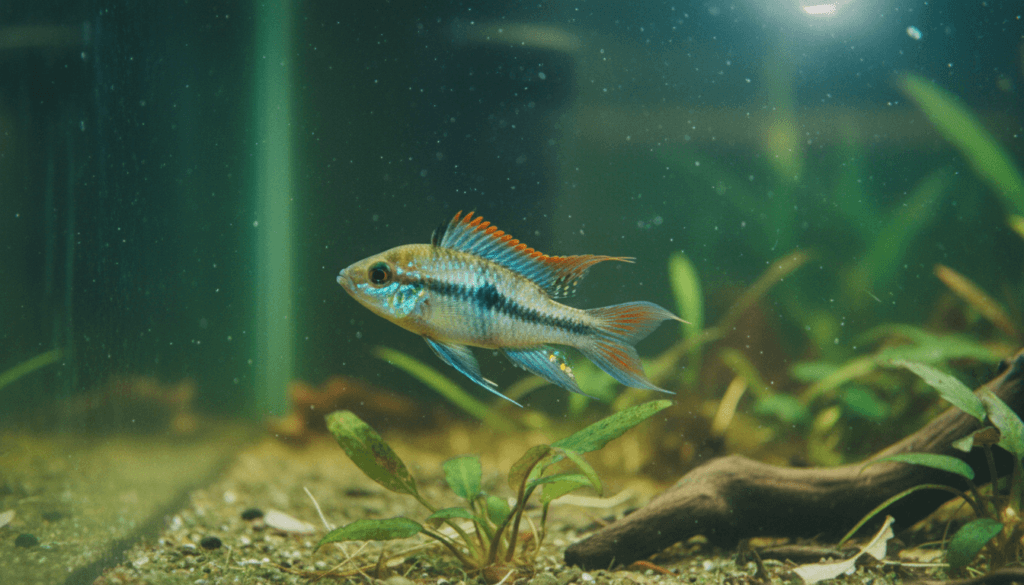
Think low flow, lots of hiding spots, and dim, filtered light. In a planted aquarium, floating plants like Salvinia or small-leaved duckweeds recreate dappled shade. Java fern and Bolbitis anchored to driftwood replicate root tangles found in the wild.
Сare and maintenance
Water parameters
| Parameter | Value |
|---|---|
| Temperature | 24–28°C (75–82°F) |
| pH | 5.5–7.0 (ideal 6.0–6.8) |
| General hardness (GH) | 0–8°dGH (soft to moderately soft) |
Keep a digital thermometer and a reliable test kit for pH and GH. Small shifts are tolerable, but rapid swings cause stress. If municipal water is hard, use reverse osmosis (RO) with remineralizer or mix RO with tap water to reach target GH and pH.
Tank size
| Parameter | Value |
|---|---|
| Minimum volume | 40 liters (≈10 US gallons) |
| Recommended dimensions | Length ≥60 cm (24 in) over height; wider tanks preferred to provide territory |
A 40 L (10 US gal) tank is the absolute minimum for a single pair plus a few dither fish, but a 60–80 L (15–20 US gal) tank gives more stable water parameters and room for territory separation. Apistogramma males are territorial along the length of the tank, making longer tanks preferable to taller ones.
Filtration and water flow
Use a sponge filter or canister with a sponge prefilter to soften outflow. Preferred flow is low to moderate—enough to keep water oxygenated without disrupting leaf litter or fry. Sponge filters provide biological filtration and gentle circulation, and they double as a safe zone for fry and dither fish. If using a hang-on-back or canister filter, direct the outflow at the surface or through spray bars to reduce current in the lower levels where these fish feed and spawn.
Substrate and decor
Fine sand or smooth, small-grain gravel suits this species best; it allows natural digging and prevents scale/nape injury. Add pieces of driftwood, smooth rocks, and ceramic or coconut caves for spawning sites. A scattering—never a compact layer—of dried catappa (Indian almond) leaves or oak leaves releases tannins and creates microhabitats for fry and biofilms that supplement diets.
Fast-rooting stem plants (Rotala, Ludwigia) in background areas and rosette plants (Cryptocoryne, Echinodorus) in midground work well. Attach Java fern and Anubias to wood and rock. Keep open swimming lanes in the center of the tank for males to patrol.
Lighting
Low to moderate intensity is best. Aim for 0.3–0.6 watts per liter (or a moderate LED fixture) with a photoperiod of 8–10 hours per day. Some shade helps: floating plants or taller marginal plants cut direct lighting and simulate the fish’s natural shady environment. Strong, continuous bright light stresses Apistogramma and encourages algae on leaf litter.
Water changes
Perform weekly water changes of 20–30% to maintain water chemistry and reduce dissolved organics. When keeping multiple Apistogramma or during conditioning/breeding, increase to two weekly 20% changes. Use temperature-matched water and mix RO water with trace-mineral additive if tap water is hard.
Social behavior and group size
Keep a single male with one or two females in a 60–80 L tank, or maintain small harems in larger tanks with plenty of rockwork and cover. Minimum group size for social stability is one male and one female; keeping multiple males requires ample length and well-defined territories to avoid continuous aggression. Females can be protective of fry and will chase tankmates away from the chosen cave.
Additional behavioral care tips
- Provide at least two caves per female so a female can retreat without surrendering the male’s preferred site.
- Use subdued decoration colors—natural browns and greens reduce stress compared to bright artificial ornaments.
- Introduce Apistogramma last to an established community so territories are defined without upheaval of the whole tank.
- When moving fish between water sources, acclimate slowly (drip acclimation) to avoid osmotic shock.
Compatibility
| Tankmate | Compatible | Note |
|---|---|---|
| Neon tetra (Paracheirodon innesi) | Yes | Small schooling fish; peaceful and occupy mid-water column |
| Corydoras spp. | Yes | Bottom-dwelling, peaceful; help clean leftover food |
| Otocinclus spp. | Yes | Algae eaters; need well-established biofilm and similar water parameters |
| Angelfish (Pterophyllum) | No | May bully or eat dwarf cichlids; incompatible in most setups |
| Larger Central American cichlids | No | Aggressive and territorial; will dominate or injure Apistogramma |
| Small rasboras (e.g., Boraras spp.) | Yes | Good small dither fish that stay out of territories |
| Shrimps (Neocaridina) | Maybe | Large Apistogramma may predate on shrimplets; adult shrimp might be eaten during breeding |
Feeding the Apistogramma Trifasciata
These fish are micropredators—preferring small live or frozen fare. Offer a varied diet: live foods (Daphnia, Artemia nauplii, glassworms), frozen options (bloodworms, mysis, blackworms), and high-quality sinking pellets or granules designed for carnivores. Incorporating at least two frozen varieties weekly reduces the risk of nutritional deficiencies.
Feeding schedule: 1–2 small feedings per day. Avoid overfeeding—uneaten food degrades water quickly and causes health issues. During conditioning for breeding, increase protein-rich feeds to two to three times per day for 7–10 days, using live or frozen options to stimulate gonad development.
For fry: start with infusoria or commercially available liquid fry foods for the first 3–5 days, then progress to microworms and Artemia nauplii as the fry grow. Live foods improve growth rates, but powdered fry foods can bridge gaps where live cultures are unavailable.
Reproduction
Apistogramma trifasciata are cave spawners. To encourage spawning, set up multiple small caves (half broken flower pots, coconut halves, or cork bark) and soften water slightly toward the lower end of the species’ pH range. Provide high-protein foods for conditioning. Females choose the cave and become the primary caregiver; males patrol and defend the broader territory.
Typical timeline: eggs are guarded by the female and hatch in about 2–4 days depending on temperature. Fry become free-swimming about 4–7 days after hatch. Move fry to a rearing tank only if predation is an issue; otherwise leave them with the mother, but monitor for hungry tankmates.
For controlled breeding: isolate a conditioned pair in a 40–60 L tank with dim light and leaf litter. Keep water changes frequent but small (10–15%) to maintain chemistry. Remove the male to a separate tank only if he becomes hyper-aggressive toward the female post-spawning.
FAQ
Q: How many Apistogramma trifasciata can be kept in a 60 L tank?
A: One male with one or two females is the practical limit in a 60 L (15–16 US gal) tank if plenty of caves and cover are provided. Multiple males require larger, longer tanks to prevent chronic fighting.
Q: Can Apistogramma trifasciata live in tap water?
A: Tap water can be used if adjusted to the species’ preferred parameters—softened (or mixed with RO water), and dechlorinated. Test pH and GH regularly. If tap GH is high (>10°dGH), mix with RO water and use a remineralizer to hit 0–8°dGH.
Q: What is the best first food for fry?
A: Infusoria or commercially available liquid fry foods for the first 3–5 days, then microworms and Artemia nauplii as the fry grow. Powdered high-protein fry foods are an alternative if live cultures are unavailable.
Q: Are Apistogramma trifasciata aggressive to shrimp?
A: They may eat shrimplets and sometimes hunt adult shrimp, especially during feeding or breeding. Keep shrimp and Apistogramma together only if the priority is a mixed tank and frequent shrimp losses are acceptable.