Rocket Killifish Care: Tiny Clown Killi, Big Personality
General information
Four centimeters. That is roughly the maximum size you can expect from a fully grown rocket killifish, and most adults stay closer to 3–3.5 cm. Despite that tiny frame, Pseudepiplatys annulatus (formerly Epiplatys annulatus) is one of the most recognizable killifish in the hobby. Its striped body and flame-colored tail have earned it several common names, including clown killifish, banded panchax and clown panchax.
It belongs to the family Nothobranchiidae, the African killifish group that also includes the famous Nothobranchius annuals. Unlike those short-lived annuals, the rocket killi is a non-annual species. Its eggs do not need a dry incubation period, and a well-kept individual typically lives 2–3 years.
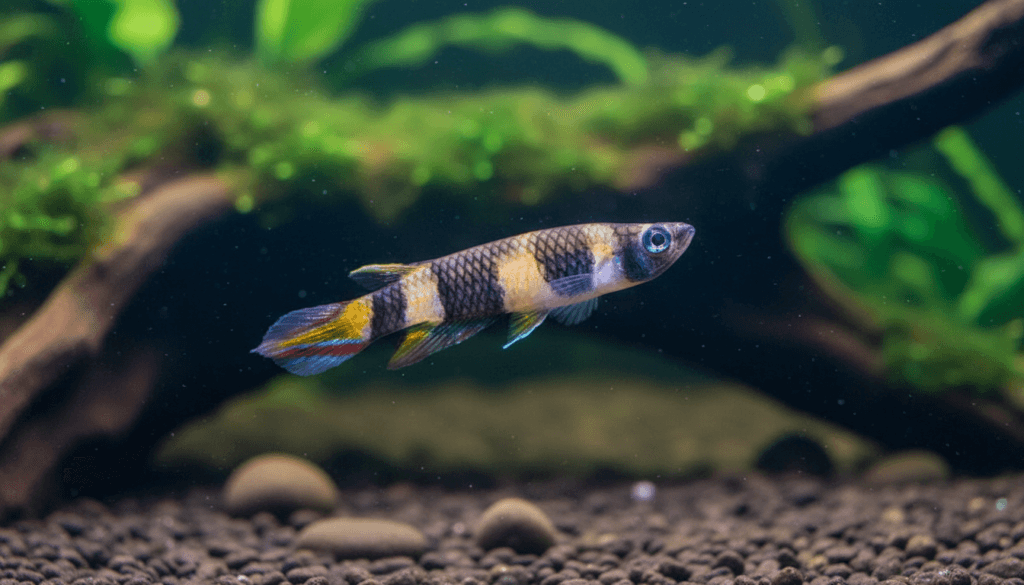
This is a surface fish through and through. You will spend most of your viewing time looking at the top 5 cm of the water column, where it hovers motionless under floating leaves and waits for something edible to land. It suits dedicated nano setups and biotope tanks. It does not suit busy community aquariums with boisterous fish.
Appearance
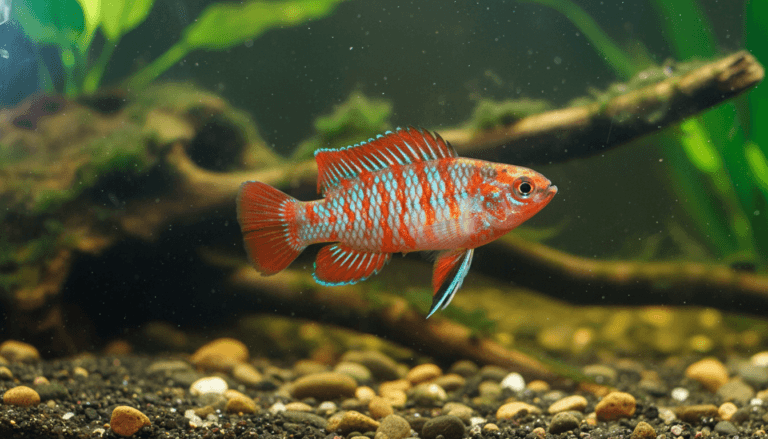
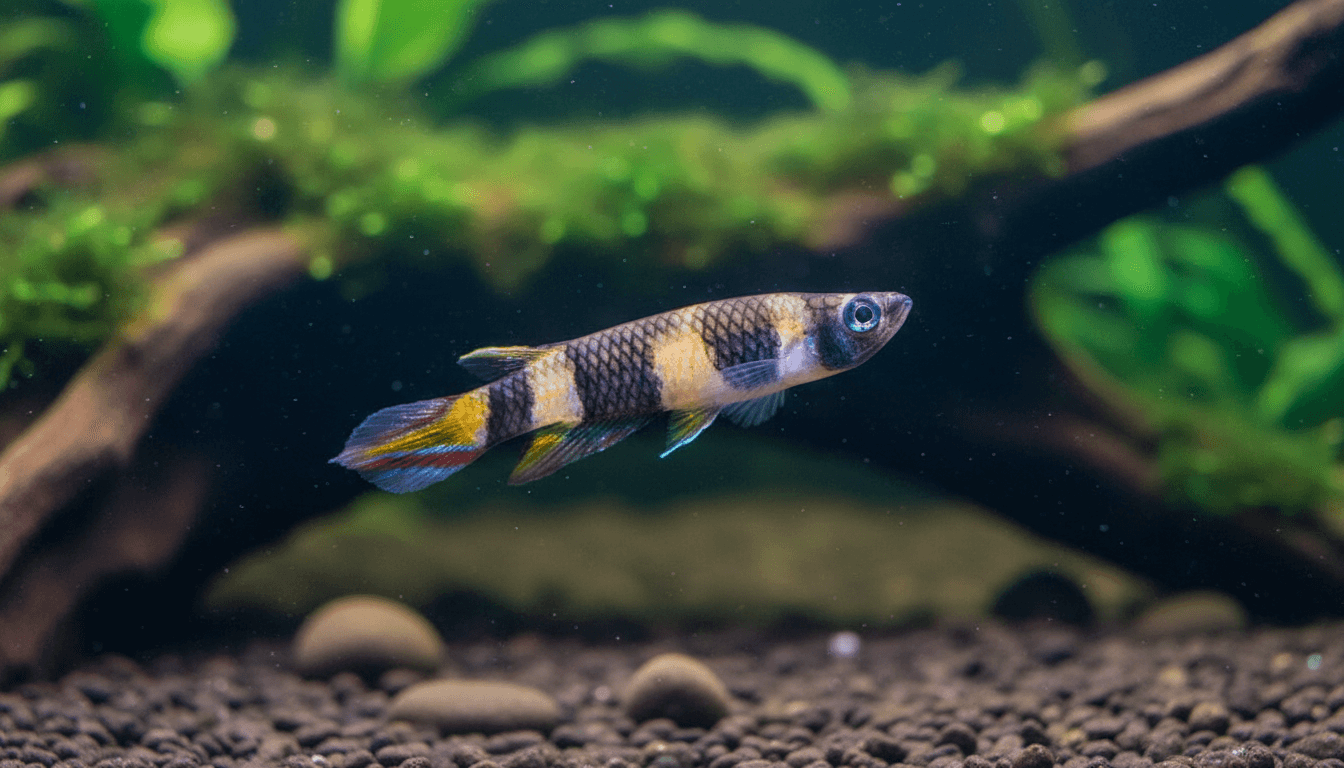
The base color is a pale cream to light yellow. Over it run four broad, dark brown to black vertical bands, giving the fish the “clown” look that inspired one of its names. The snout is often tinted blue or pale lilac, and the eyes are large relative to the head, with a reflective ring that catches light from above.
The tail is the real showpiece. In males, the central rays of the caudal fin extend into a pointed, elongated tip, and the fin is painted in red, orange and electric blue. Viewed from above as the fish darts toward food, the shape resembles a rocket’s exhaust flame. The dorsal fin sits far back on the body, close to the tail, which is typical of surface-feeding killifish.
Sexing adults is easy:
- Males show the extended, brightly colored tail and red or blue edging in the dorsal and anal fins.
- Females have a rounded, mostly clear tail and plainer fins.
- Females tend to be slightly smaller and look fuller around the belly when carrying eggs.
- Juveniles under about 1.5 cm look nearly identical, so buying young fish means accepting some guesswork on sex ratio.
Some populations are sold with locality codes, such as fish collected in Guinea or Liberia. Color intensity varies slightly between them, so if you plan to breed, avoid mixing different localities.
Habitat
The species comes from coastal West Africa, with a range covering parts of Guinea, Sierra Leone and Liberia. Its natural waters are small and shallow: swamps, flooded forest margins, slow creeks and grassy pools, frequently only a few centimeters deep.
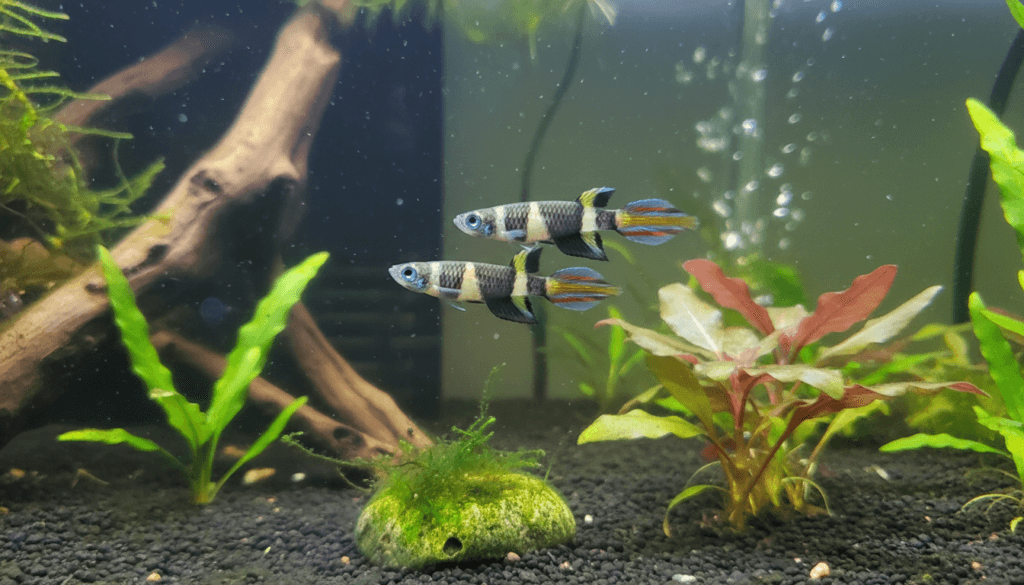
These waters are generally very soft and acidic, stained brown by tannins from decaying leaves. Dense marginal vegetation and overhanging grasses provide shade and cover. Current is minimal or absent. The fish feed mainly on tiny insects that fall onto the surface and on aquatic invertebrate larvae.
That background explains most of its aquarium needs. A rocket killi evolved for calm, shaded, soft water with a crowded surface — not for bright, open tanks with strong filtration.
Сare and maintenance
Water parameters
Soft, slightly acidic water brings out the best coloration and makes breeding far more likely. Captive-bred stock tolerates somewhat harder water, but do not push it beyond the limits below.
| Parameter | Value |
|---|---|
| Temperature | 22–26 °C (72–79 °F); 24 °C is a good target |
| pH | 5.0–7.0, ideally 5.5–6.5 |
| General hardness (GH) | 1–6 °dGH (roughly 20–100 ppm) |
| Ammonia / nitrite | 0 ppm |
| Nitrate | Below 20 ppm |
If your tap water is hard, mix it with RO water. Adding catappa (Indian almond) leaves or alder cones will lower pH slightly and tint the water amber.
Tank size
Because this fish uses only the surface layer, footprint matters far more than height.
| Parameter | Value |
|---|---|
| Minimum volume (pair or trio) | 20 L (about 5 US gallons) |
| Recommended volume (group of 6–10) | 40–60 L (10–15 US gallons) |
| Recommended dimensions | At least 40 × 25 cm footprint; 45–60 cm length preferred |
| Water depth | 20–25 cm is plenty |
A shallow “rimless nano” or a long, low breeder-style tank is ideal. Tall column tanks waste volume the fish will never use.
A tight-fitting lid is mandatory. Rocket killies jump, and a gap of a few millimeters around cables is enough to lose one. Cover openings with filter foam or mesh.
Filtration and water flow
Use an air-driven sponge filter. It provides biological filtration, gentle surface movement and zero risk of sucking in fry. Set the airflow low with a small valve so the surface barely ripples.
Hang-on-back and canister filters are usually too strong. If you must use one, baffle the output with a sponge or aim it at the glass. In heavily planted, lightly stocked tanks, some keepers run no filter at all and rely on plants plus frequent water changes, but a beginner should keep a sponge filter running.
Substrate and decor
Substrate has little practical impact since the fish rarely go to the bottom. Fine dark sand or an inert dark gravel looks natural and makes the pale body bands stand out. Bare-bottom works well in breeding tanks.
Build the scene around the upper water layer:
- Floating plants: Salvinia natans, Phyllanthus fluitans (red root floaters), Limnobium laevigatum or duckweed (Lemna minor).
- Fine-leaved plants reaching the surface: Java moss (Taxiphyllum barbieri), Ceratopteris thalictroides (water sprite) or hornwort (Ceratophyllum demersum).
- A few thin driftwood branches angled toward the surface for extra cover.
- A layer of catappa or oak leaves on the bottom to release tannins and grow microfauna.
Leave some open water between floating plant patches. The fish need space to spot food and pick it off the surface.
Lighting
Low to moderate light is best. A simple LED at low intensity, running 8–10 hours daily, keeps plants alive without washing out the fish. Floating plants should shade at least half of the surface.
Under bright, open lighting, rocket killies hide more and their colors look paler. In dim, tannin-stained water, the red and blue of the male’s tail appear noticeably richer.
Water changes
Change 20–30% of the water weekly. In a small tank, two smaller changes of 15% per week are gentler and keep parameters more stable.
Match the new water’s temperature and hardness closely. Soft-water fish in tiny volumes react badly to sudden swings, and the sudden arrival of hard tap water can be stressful. Siphon uneaten live food and debris from the bottom during each change.
Social behavior and group size
This is not a schooling fish, though it does feel more secure around its own kind. Keep a minimum of one male with two or three females. In tanks of 40 L or more, a group of 6–10 fish with more females than males works nicely.
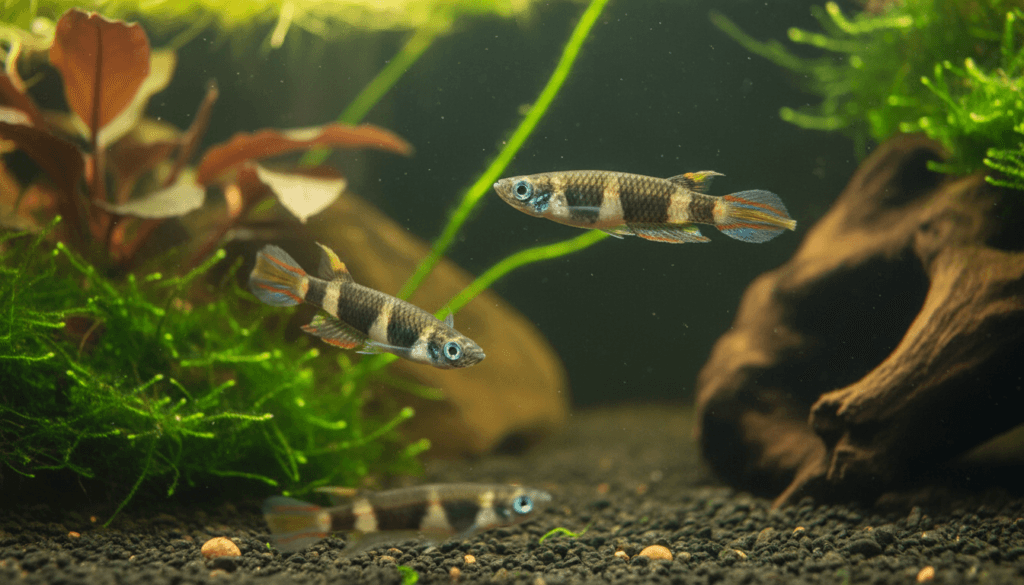
Males display to each other with spread fins and short chases. Serious injuries are rare, but a lone subordinate male in a small tank may be harassed constantly. With several males, provide plenty of floating cover so they can break line of sight.
Additional behavioral care tips
New fish are often extremely shy for the first week or two. Keep the room calm and avoid tapping the glass.
- Feed near floating cover at first; the fish will not venture into open water until settled.
- Expect them to hover in one spot for long periods. That stillness is normal hunting behavior, not illness.
- Keep the lid on during feeding. Startled fish jump straight upward.
- Acclimate slowly by drip over 45–60 minutes, especially when moving fish from harder water.
Compatibility
Size is the limiting factor. Anything with a mouth large enough to swallow a 3 cm fish is a risk, and fast, greedy feeders will steal every meal from the surface.
| Tankmate | Compatible? | Note |
|---|---|---|
| Neocaridina / Caridina shrimp | Yes | Adults are safe; some shrimplets may be eaten. |
| Pygmy corydoras (Corydoras pygmaeus) | Yes | Occupy a different level and share soft-water needs. |
| Chili rasbora (Boraras brigittae) | Yes | Peaceful and tiny; mid-water swimmers. |
| Otocinclus | Yes | Fine in larger, mature tanks with biofilm. |
| Small snails (ramshorn, nerite) | Yes | Help clean up leftover food. |
| Hatchetfish | No | Compete directly for the surface zone. |
| Guppies and other livebearers | No | Faster feeders; prefer harder water. |
| Betta splendens | No | Also a surface dweller; may attack or outcompete. |
| Dwarf cichlids (e.g. Apistogramma) | Caution | Possible in larger tanks, but they may eat eggs and fry. |
| Other killifish species | No | Females of different species look alike; hybridization risk. |
A species-only tank is the simplest option if breeding is the goal.
Feeding the Rocket Killifish
Most wild-type fish ignore dry food at first. Live food is the most reliable starting point, and it keeps colors at their brightest.
Good options, from smallest to largest:
- Vinegar eels and microworms (Panagrellus species) for young fish.
- Freshly hatched brine shrimp (Artemia nauplii).
- Daphnia and Moina, which float in the upper layer where the fish hunt.
- Flightless fruit flies (Drosophila melanogaster or D. hydei) — the closest match to their wild diet.
- Springtails, which float and can be cultured on charcoal.
Frozen daphnia, cyclops and baby brine shrimp are accepted by most captive-bred fish. Floating micro-pellets or crushed flake may be taken eventually, but they should not be the main diet. Sinking foods are mostly wasted.
Feed small amounts once or twice daily. The mouth is tiny, so anything larger than an adult brine shrimp is usually too big. If the bellies look slightly rounded after feeding, the portion is right.
Reproduction
Breeding rocket killies is straightforward in terms of spawning. Raising the fry is the hard part.
Set up a 10–20 L tank with soft water (GH under 4), pH around 6.0 and a temperature of 24–25 °C. Add a sponge filter on very low airflow, a thick layer of floating plants and a clump of Java moss or a synthetic spawning mop at the surface. Introduce one male with two or three well-fed females.
Spawning happens nearly every day. The pair drifts side by side into the plant roots or moss, and the female releases one or a few eggs at a time. Each egg is about 1 mm across, clear and sticky. Over a week, a healthy female may produce several dozen.
You have two choices:
- Natural method: leave the adults in a heavily planted tank. Adults eat relatively few eggs and fry, so some young will survive, usually in low numbers.
- Egg collection: pick eggs from the mop every 2–3 days and place them in a small dish or container of tank water with a catappa leaf or a drop of methylene blue to prevent fungus. Remove any white, fungused eggs daily.
At 24 °C, the eggs hatch in about 10–14 days. The fry are among the tiniest you are likely to raise — roughly 2 mm — and they stay pinned to the surface. For the first week, feed infusoria or paramecium cultures. After that, move to vinegar eels and microworms, then to baby brine shrimp once they can take it, usually around 2–3 weeks old.
Keep fry water shallow, around 3–5 cm, so food stays concentrated near them. Grow-out takes about 3–4 months to sexual maturity. Separate batches by size if larger siblings start picking on smaller ones.
FAQ
Can rocket killifish live in a community tank?
Only a very gentle one. Tiny, calm fish like chili rasboras or pygmy corydoras work. Surface dwellers and fast eaters such as guppies or hatchetfish will steal food and stress them.
Do rocket killifish need a heater?
In most homes, yes. They do best at 22–26 °C. If your room stays reliably within that range, a heater is optional, but a small adjustable heater avoids overnight temperature drops.
Why is my rocket killifish not eating flakes?
Wild-type and newly imported fish often ignore dry food completely. Start with live daphnia, baby brine shrimp or fruit flies, then introduce frozen food. Flakes may be accepted later, crushed finely.
How many rocket killifish can go in a 5 gallon tank?
A 20 L (5 gallon) tank comfortably holds one male and two or three females. For more males, move up to 40 L or larger and add extra floating cover.