Zebra Acara (Nannacara adoketa): Complete Care Guide
General information
The Zebra Acara is a small South American cichlid that rewards patience. Sven O. Kullander and Soraia Prada-Pedreros described Nannacara adoketa in 1993. The species name comes from the Greek word for “unexpected,” a fitting label for a fish that turned up long after its better-known relatives Nannacara anomala and Nannacara taenia were already in the hobby. You will also see it sold as the banded acara or banded dwarf acara.
It belongs to the tribe Cichlasomatini. That places it closer to the larger “acaras” such as Aequidens and Cleithracara than to Apistogramma, even though it shares shops, tank setups and hobby circles with apistos. The practical consequence? Its body is deeper and chunkier than an apisto’s, and its breeding behavior follows a slightly different pattern.
Availability is patchy. Most fish in the trade are captive-bred in Europe or by specialist hobbyists, with occasional wild imports from Brazil. Expect to pay more than you would for common dwarf cichlids. You may also need to order through a specialist retailer or a cichlid club auction.
Appearance
Adult males reach about 7–8 cm (roughly 3 in) total length. Females stay noticeably smaller, typically 5–6 cm. That makes the Zebra Acara one of the larger members of its genus, though still firmly in dwarf cichlid territory.
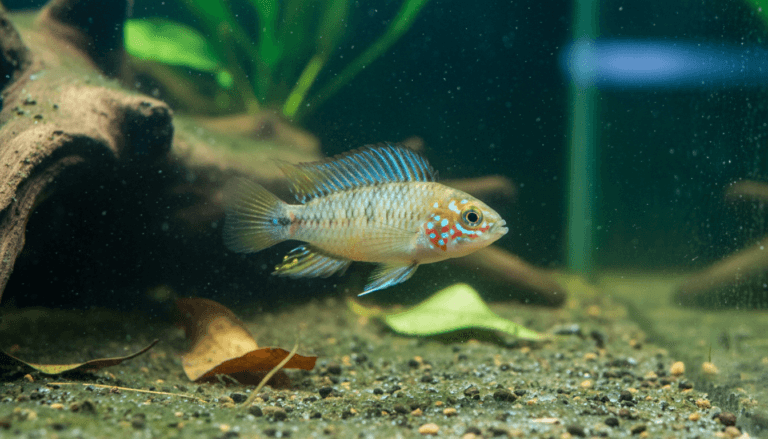
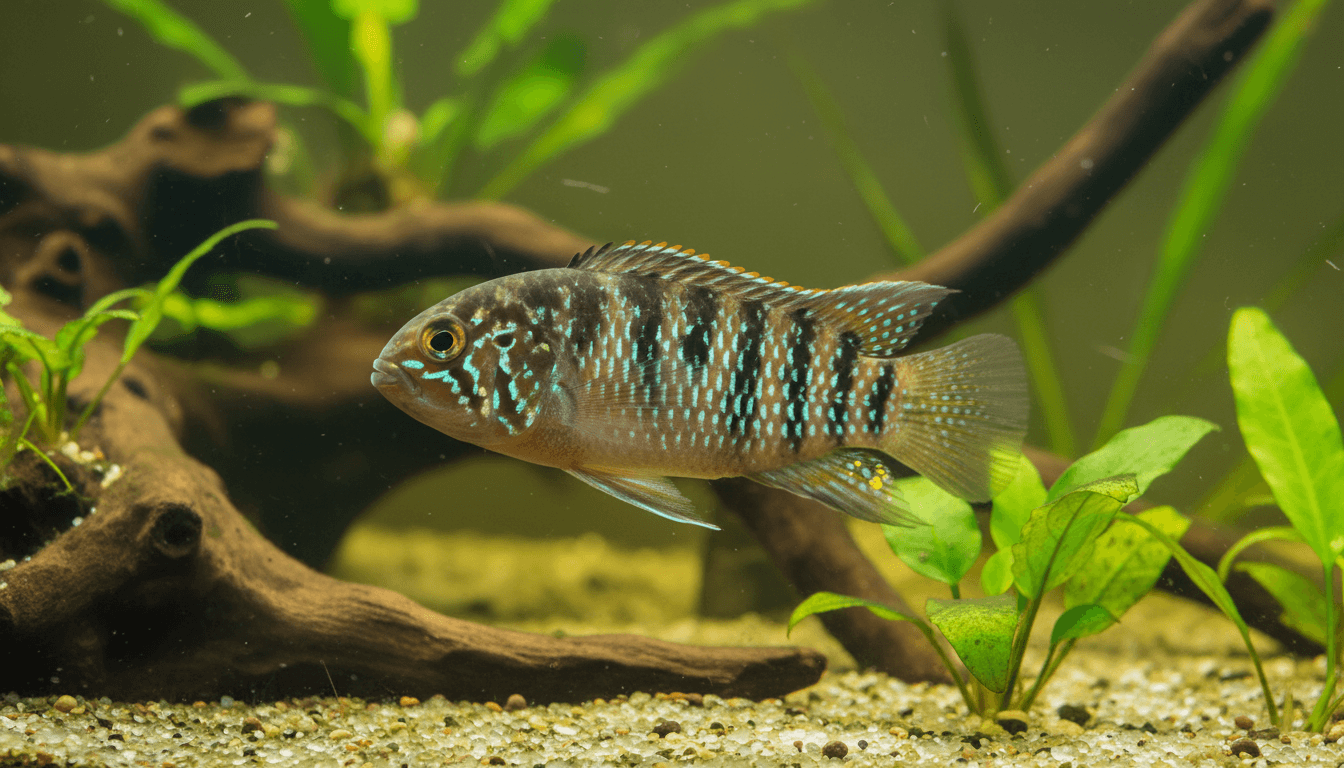
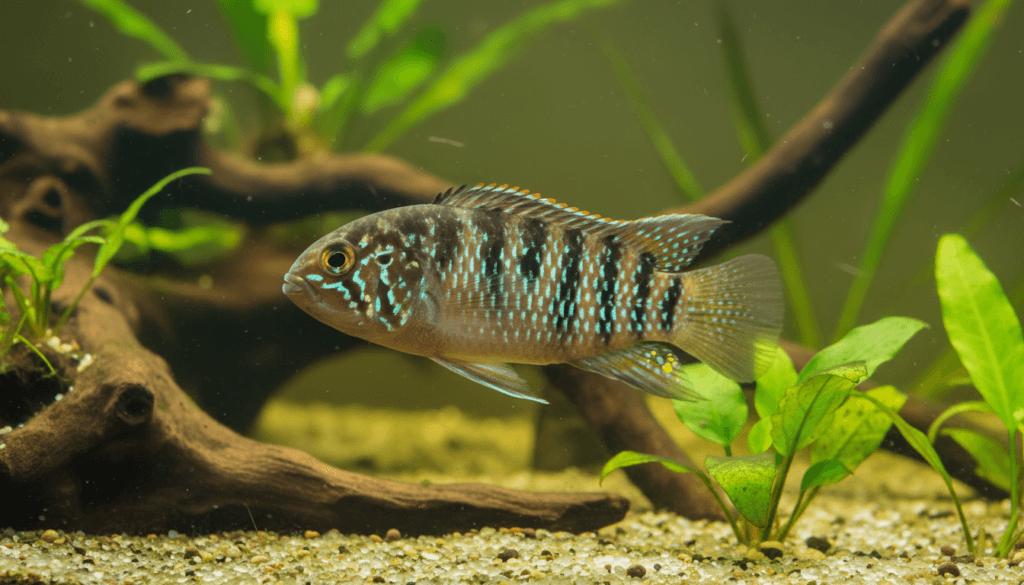
The base color is a warm beige to greyish-brown. Across it run a series of dark vertical bars, usually seven or eight, which give the fish its common name. A horizontal midlateral band often shows through as well, so a relaxed fish can look faintly checkered. How dark the pattern appears depends heavily on mood.
- Males develop longer, pointed tips on the dorsal and anal fins, and their fins can carry a blue-green sheen with fine reddish spotting.
- Females are rounder and plainer outside the breeding period.
- A brooding female transforms into high-contrast black-and-white, with bold bars and a pale background. This is a signal to fry and a warning to everything else.
- Stressed or newly introduced fish fade to washed-out grey with blotchy markings.
Scales on the flanks may show an iridescent turquoise edge under the right light. Blackwater tint and dark substrate bring this out far better than bright white sand.
Habitat
Nannacara adoketa comes from the Rio Negro basin in the Brazilian state of Amazonas. The Rio Negro is the classic blackwater river. Its tea-colored water is stained by humic and tannic acids leaching from rotting leaves and wood, and dissolved mineral content is extremely low.
Within that system, the species lives in small forest streams and flooded margins rather than the main channel. These are shaded places with slow current, sandy bottoms and thick deposits of fallen leaves, branches and roots. Conductivity in such waters can drop below 20 µS/cm, and pH values under 5.0 are normal.
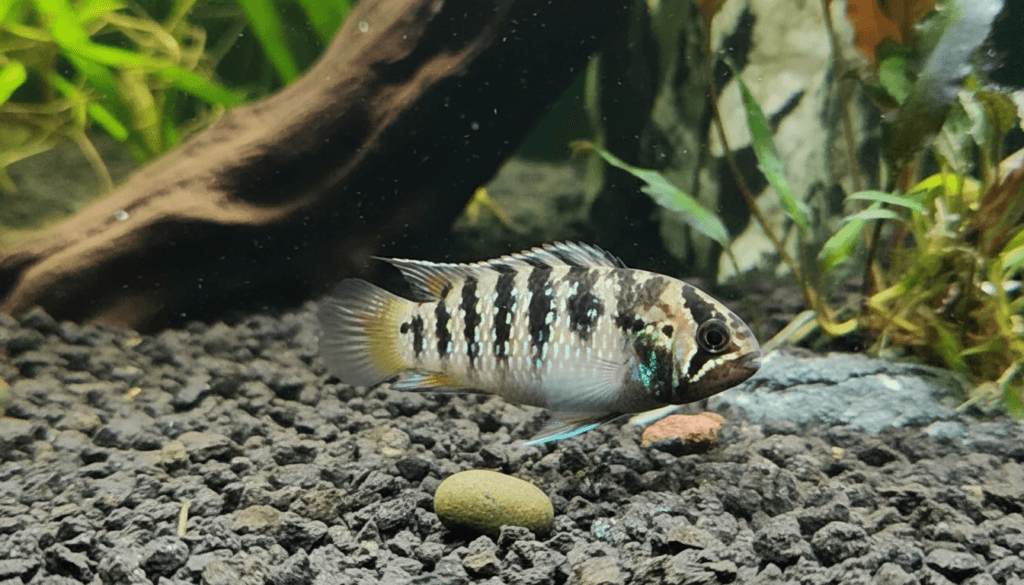
Seasonal flooding shapes life here. When water rises, fish spread into the flooded forest (igapó), where food and hiding places multiply. That annual cycle is the reason many blackwater cichlids spawn more readily after a series of cooler, softer water changes that mimic the rainy season.
Сare and maintenance
Water parameters
Soft, acidic water is not optional for long-term success. Captive-bred fish tolerate slightly harder conditions than wild ones, but breeding and coloration both suffer in hard water.
| Parameter | Value |
|---|---|
| Temperature | 24–29 °C (75–84 °F); 26–28 °C for breeding |
| pH | 4.5–6.5 (5.5–6.2 is a practical target) |
| General hardness (GH) | 1–6 °dGH |
| Carbonate hardness (KH) | 0–3 °dKH |
| Ammonia / nitrite | 0 ppm |
| Nitrate | Below 20 ppm |
If your tap water is hard, mix reverse osmosis (RO) water with a small portion of tap water or remineralize RO water with a GH-only product. Catappa leaves, alder cones and peat in a filter bag will lower pH gradually and add the tannins this fish expects.
Tank size
Floor space matters more than height. Territories are defined along the bottom.
| Parameter | Value |
|---|---|
| Minimum volume (one pair) | 60 L (about 16 US gal) |
| Recommended volume (pair plus dither fish) | 100 L (about 26 US gal) or more |
| Minimum length | 60 cm (24 in) |
| Recommended dimensions (L × W × H) | 80 × 35 × 35 cm or similar long, low layout |
| Harem (1 male, 2–3 females) | 120 L+ with a length of 90 cm or more |
Filtration and water flow
A sponge filter or a small canister with a spray bar pointed at the glass works well. Keep the current gentle. These fish come from sluggish streams and waste energy fighting strong flow.
In breeding tanks, an air-driven sponge filter is the safest choice because free-swimming fry cannot get sucked into it. Hang-on-back filters are acceptable if you cover the intake with a fine pre-filter sponge. Peat or catappa bark placed inside the filter chamber doubles as chemical conditioning.
Substrate and decor
Use fine sand, ideally dark or natural beige. The fish sift through it constantly, and coarse gravel damages their mouths and traps food waste.
Build the layout around hiding spots and visual barriers:
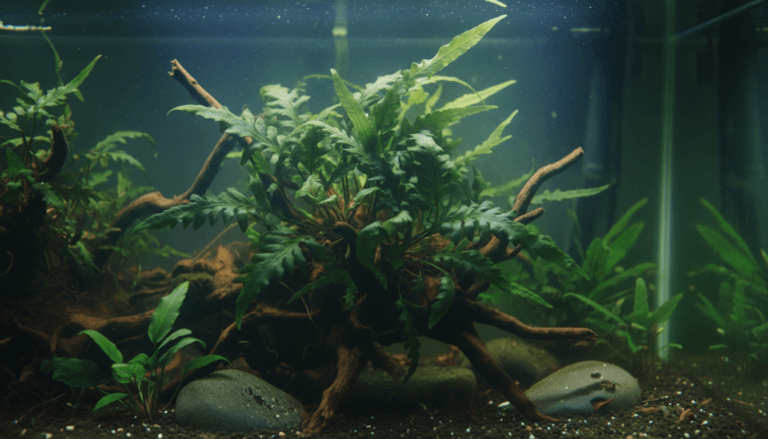
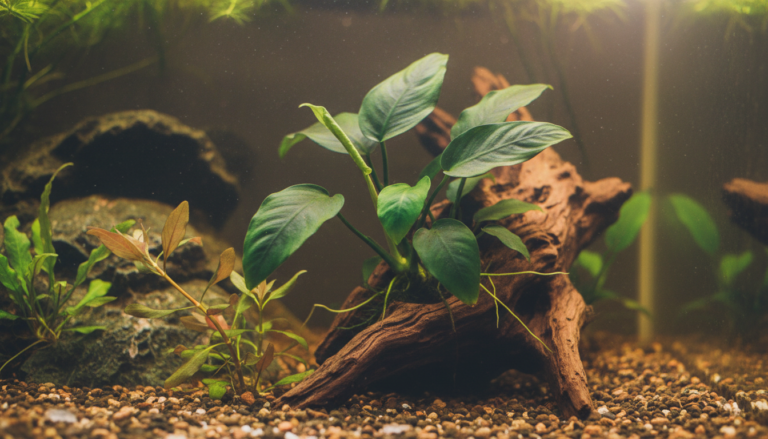
- Driftwood roots and branches, such as spider wood or Malaysian bog wood, placed to break lines of sight
- Caves: coconut shells, small clay pots laid on their sides or slate pieces stacked into overhangs
- A layer of dried leaf litter (catappa, oak or beech) covering part of the bottom
- Hardy low-light plants such as Microsorum pteropus (Java fern), Anubias barteri var. nana or Cryptocoryne wendtii
- Floating plants like Salvinia or Limnobium laevigatum (Amazon frogbit)
Provide at least one more cave than you have females. Leaf litter also grows biofilm and microfauna, which gives the fry a natural first food.
Lighting
Dim is better. Moderate-to-low intensity LED lighting for 8–10 hours a day suits both the fish and the shade-tolerant plants listed above. Floating plants covering a third to half of the surface create dappled light and reduce shyness. Under bright, open lighting the Zebra Acara tends to stay pale and hide, which defeats the point of keeping it.
Water changes
Change 20–30% of the water weekly. Match the temperature and hardness of new water closely, since sudden swings in pH can stress fish kept at very low values. Before spawning attempts, some breeders switch to smaller, more frequent changes of about 10–15% twice a week with slightly cooler, softer water to imitate the rainy season. Siphon uneaten food out of the leaf litter while you are at it.
Social behavior and group size
This is a territorial species, not a schooling one. Keep a single pair or one male with two or three females in a larger tank. Two males in anything under about 150 L will usually end in a constant turf war, and the weaker male will spend its life hiding.
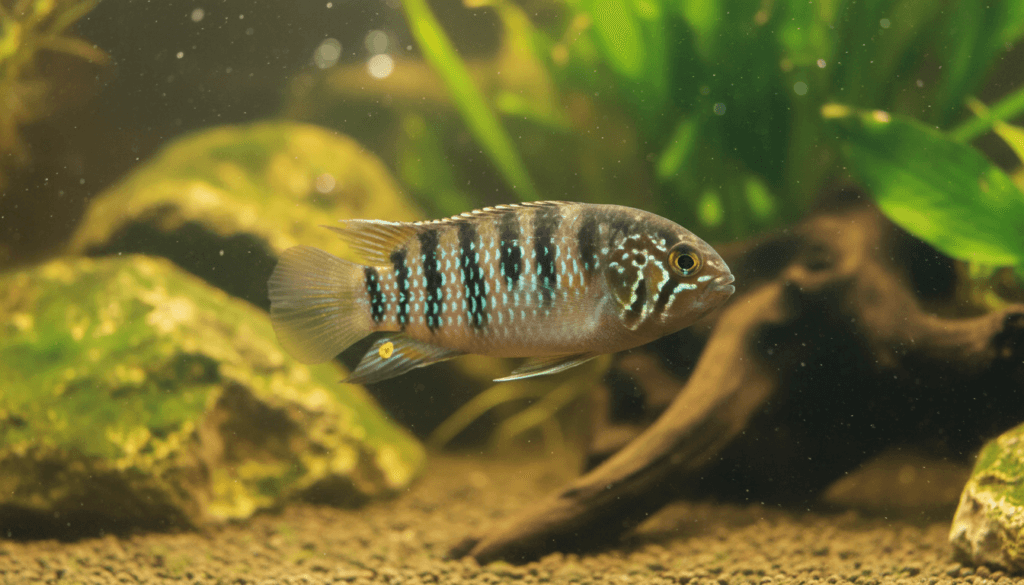
Females are the real enforcers once eggs appear. A guarding female claims the area around her cave and drives off everything, including the male. In a harem setup, each female needs her own defined zone.
Additional behavioral care tips
Add a school of peaceful dither fish. Seeing calm fish swimming in the open tells the cichlids there is no danger nearby, and they come out much more often.
Watch the male after a spawn. If the female is harassing him relentlessly and he has nowhere to go, move him out or add more cover. Rearranging decor slightly can also reset territories if one fish becomes a bully. New arrivals often sulk behind wood for several days; do not panic, just keep the lights low and feed lightly.
Compatibility
Peaceful toward fish it cannot eat, aggressive in defense of a brood. Choose tankmates that share the need for soft, acidic water and that stay in the middle or upper water column.
| Tankmate | Compatible? | Note |
|---|---|---|
| Cardinal tetra (Paracheirodon axelrodi) | Yes | A Rio Negro native and an ideal dither fish |
| Rummy-nose tetra (Hemigrammus bleheri) | Yes | Tight schooling behavior reassures shy cichlids |
| Marbled hatchetfish (Carnegiella strigata) | Yes | Occupies the surface; keep the tank covered |
| Pencilfish (Nannostomus spp.) | Yes | Peaceful and suited to the same water |
| Otocinclus spp. | Yes | Grazes algae without competing for caves |
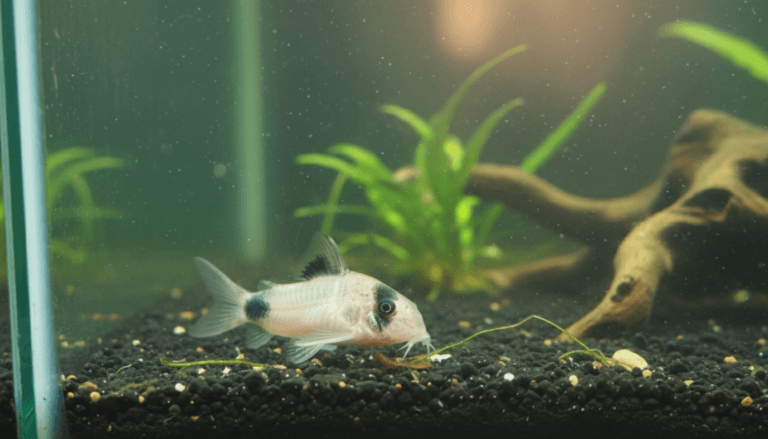
| Corydoras (C. habrosus, C. sterbai) | With caution | They may be chased from a breeding site; needs ample floor space |
| Apistogramma | With caution | Only in large tanks with separate territories |
| Angelfish (Pterophyllum) | No | Will eat fry and can outcompete adults for food |
| Cherry shrimp (Neocaridina) | No | Shrimp will be hunted; adults may survive but juveniles will not |
| Tiger barbs, other fin-nippers | No | Too boisterous and prefer harder water |
| Larger cichlids (oscars, severums) | No | Size and aggression mismatch |
Feeding the Zebra Acara (Nannacara adoketa)
In the wild, the diet consists of small invertebrates picked from sand and leaf litter: insect larvae, tiny crustaceans and worms. Mirror that in the tank with a meaty rotation.
- Frozen bloodworms, mosquito larvae and Daphnia
- Frozen or live brine shrimp (Artemia) and Mysis
- Live blackworms or grindal worms, ideal for conditioning breeders
- Quality small sinking pellets or granules for cichlids
- Crushed flake as an occasional supplement
Feed once or twice a day. Offer only what disappears within two to three minutes. Leftover food rotting in leaf litter will crash water quality quickly in soft, poorly buffered water. Wild-caught fish sometimes refuse dry food at first; start them on live or frozen items and mix in pellets gradually.
One overlooked detail: the Zebra Acara eats from the bottom. Floating flakes that tetras grab first may never reach it, so use sinking food or target-feed with a pipette.
Reproduction
Breeding is achievable in a well-set-up tank. Conditioning comes first: two weeks of generous live and frozen food, temperature around 27 °C and pH near 5.5–6.0.
Unlike most Apistogramma, which are strict cave spawners, Nannacara species will spawn in caves but also on sheltered flat surfaces, such as a leaf or a piece of slate beneath an overhang. The female signals readiness by darkening her bars and shifting to her black-and-white brood coloration. Pairs typically clean the chosen site for a day or two before laying.
A spawn usually contains somewhere between 100 and 300 small eggs. The female fans and guards them. At 27 °C expect hatching in roughly two to three days. Wrigglers are moved to pits dug in the sand and become free-swimming about five to six days later.
- Remove the male if the female attacks him constantly, or give him a separate side of the tank.
- Start fry on infusoria or commercial liquid fry food for the first two days, then switch to newly hatched brine shrimp nauplii and microworms.
- Keep an air-driven sponge filter running and change 10% of the water every other day with matching parameters.
- Expect the female to herd her fry for two to four weeks. Her bold coloration helps them follow her.
Fry grow slowly compared with livebearers. At around 1 cm they can take crushed flake and micro pellets. Separate them from the parents before the next spawn, because a new brood makes the female drive the older young away.
FAQ
Is the Zebra Acara good for beginners?
Not as a first fish. It is hardy enough once settled, but it needs soft, acidic water and stable conditions. If you can already keep a planted tank with low GH and steady parameters, it is a sensible step up from tetras.
How can you tell a male Zebra Acara from a female?
Males grow larger, up to about 8 cm, with extended pointed tips on the dorsal and anal fins. Females are smaller and rounder with shorter fins. In breeding condition, the female also turns sharply black and white.
Can a Zebra Acara live with shrimp?
Dwarf shrimp like Neocaridina or Caridina will be hunted, especially baby shrimp. Larger Amano shrimp (Caridina multidentata) sometimes survive in a heavily planted tank. There are no guarantees.
Why is my Zebra Acara pale and hiding?
Common causes include bright lighting, lack of cover, no dither fish, hard water or a dominant tankmate. Add floating plants and caves, introduce a school of cardinal tetras and check your GH and pH. Newly added fish usually color up within one to two weeks once they feel secure.