
Rainbow Cichlid Care: Diet, Tankmates and Breeding Guide
General information
You may want a Central American cichlid but lack the space for a convict colony or a 30 cm Red Devil. The rainbow cichlid is one of the few fish that fits that gap. Adult males rarely exceed 12–13 cm, females stay around 8–10 cm, and the species is far less destructive than most of its relatives.
The name has shifted over the decades. It was described as Heros multispinosus by Günther in 1867 and spent most of the 20th century as Herotilapia multispinosa. It was later placed in Archocentrus, and some recent authors have moved it back to Herotilapia. You will see all of these names on dealer labels. They refer to the same fish.
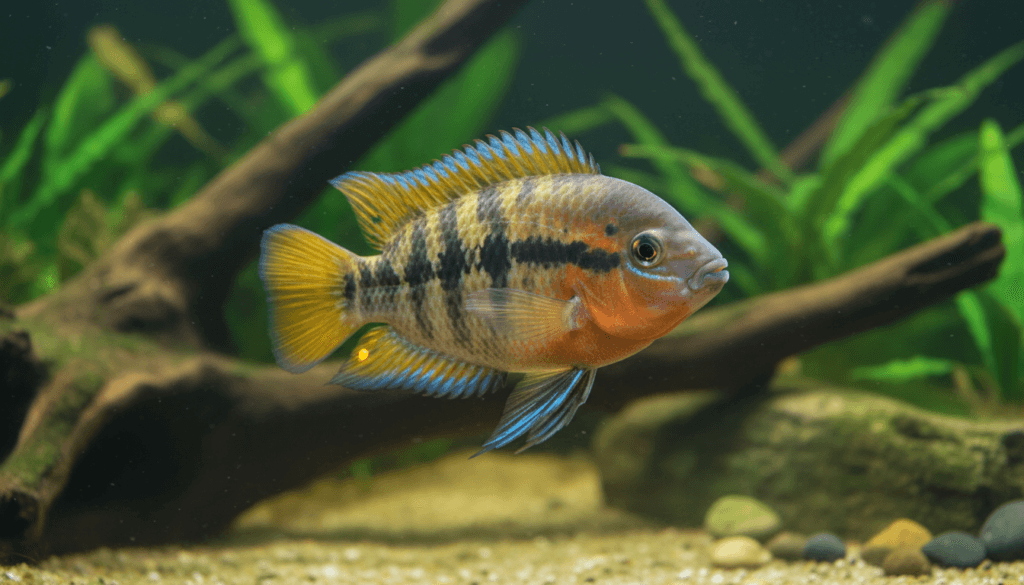
“Multispinosus” means “many spines.” Count the dorsal fin on an adult and you will find roughly 17–19 hard spines, noticeably more than on most cichlids of similar size.
One detail sets this species apart from nearly every other Central American cichlid: its teeth. Each tooth ends in three small points (tricuspid), an adaptation for scraping algae and biofilm off hard surfaces. That dentition explains the fish’s diet and why it does poorly on a pure meaty menu. Expect a lifespan of 8–12 years with good care.
Appearance
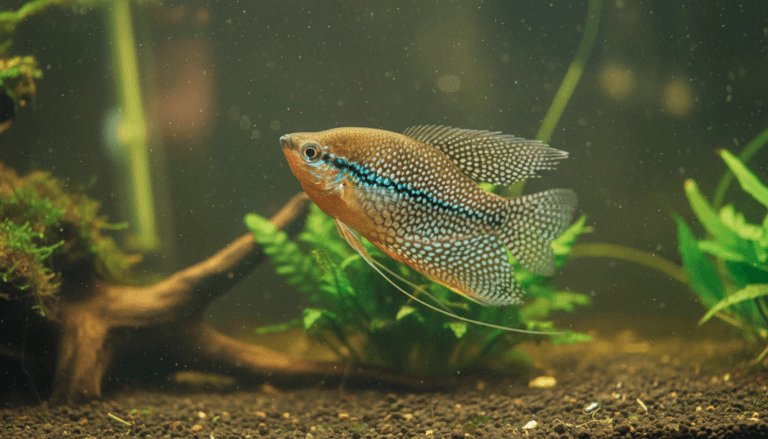
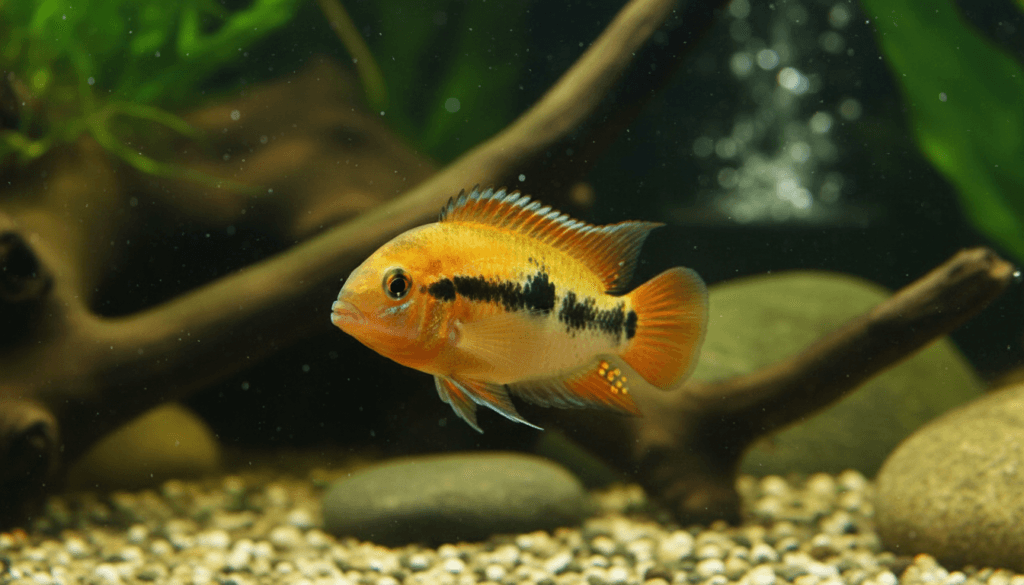
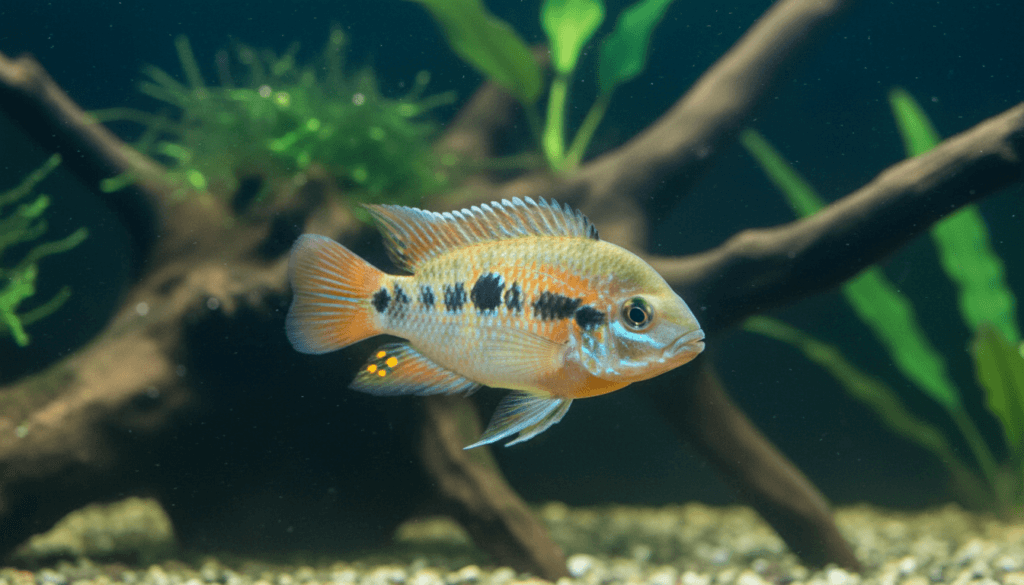
A rainbow cichlid is a moody fish, and its colors are not fixed. In a relaxed, non-breeding state, the body is olive-gold to bright yellow with a dark horizontal band running from the eye toward the tail. A darker blotch usually sits near the middle of the flank. The fins can show orange or red edges, and the eye is often red.
Once a pair starts guarding eggs, the pattern flips. The lower half of the head and body turns sooty black, while the upper back stays yellow or gold. The contrast is striking and signals to every other fish in the tank that the pair is on duty. Stressed or subordinate fish take on a washed-out gray with vertical barring.
Sexing adults is fairly easy:
- Males grow larger and develop longer, pointed dorsal and anal fins.
- Females are rounder and stay shorter.
- Only during spawning does the blunt, conical breeding tube (ovipositor) of the female show clearly.
- Older males may develop a slightly steeper forehead, though nothing like the nuchal hump of a flowerhorn.
A golden or “gold rainbow” morph is also sold. It lacks most of the dark melanin pattern and shows pale yellow with pinkish tones. Care requirements are identical.
Habitat
The species ranges from southern Honduras through Nicaragua into northwestern Costa Rica. It is found on both the Pacific and Atlantic drainages, with well-known populations in Lake Nicaragua and Lake Managua and the rivers feeding them.
Much of its range is lowland, with slow-moving streams, lake margins and swampy backwaters. Water in these places tends to be warm, somewhat turbid and neutral to alkaline. Bottoms are mud or sand scattered with sunken wood, leaf debris and rocks coated in algae. Seasonal flooding pushes the fish into shallow vegetated zones, where pairs claim a patch of bottom and spawn.
If you build a biotope, think “Nicaraguan lake shore” rather than “Amazon blackwater.” Clear to slightly cloudy water suits it best, with a sandy bottom and plenty of hard surfaces for grazing.
Сare and maintenance
Water parameters
This fish is tolerant. Stability matters more than hitting an exact number, so avoid chasing pH with chemicals.
| Parameter | Value |
|---|---|
| Temperature | 24–28 °C (75–82 °F); tolerates 22–30 °C |
| pH | 7.0–8.0 |
| General hardness (GH) | 8–20 °dGH |
| Ammonia / nitrite | 0 ppm |
| Nitrate | Below 30 ppm |
For breeding, the warmer half of the range (26–28 °C) works well. Very soft water under 4 °dGH with a pH near 6 is a poor match for this species.
Tank size
| Parameter | Value |
|---|---|
| Minimum volume (single pair) | 110 liters / 30 US gallons |
| Recommended volume (pair plus tankmates) | 200 liters / 55 US gallons or more |
| Minimum length | 80 cm (32 in) |
| Recommended dimensions | 100 × 40 × 45 cm (L × W × H) |
Footprint beats height here. The rainbow cichlid lives and breeds on the bottom, so a long, shallow tank gives a pair a territory while leaving space for dither fish to escape. A 60 cm cube of the same volume is a worse choice than a 100 cm standard tank.
Filtration and water flow
Use a filter rated for at least 4–5 times the tank volume per hour. A canister filter or a large hang-on-back unit works well for a 200-liter setup. In a breeding tank, add an air-driven sponge filter as a second unit, since it will not suck up free-swimming fry.
Keep the current moderate. These fish come from slow water and struggle to hold position in strong spray-bar blasts. Point the outflow along the surface or at the glass to break it up. Cover the intake of any power filter with a pre-filter sponge once you have eggs in the tank.
Substrate and decor
Choose fine sand or smooth pea gravel of 1–3 mm. Rainbow cichlids dig, especially when breeding, and sharp gravel can damage their mouths. The digging is mild compared with a convict or a Jack Dempsey, but plan for pits near the spawning site.
Build the layout around a few key elements:
- Flat slate or smooth river stones as spawning sites. Females usually choose a flat stone or the inside of a cave.
- Driftwood such as Malaysian driftwood or mopani to break lines of sight between territories.
- A clay pot or coconut shell cave for shy females.
- A thin layer of Indian almond or oak leaves in one corner, which grows biofilm the fish will graze.
Plants are possible, which is not true of many Central Americans. Anubias barteri, Java fern (Microsorum pteropus) and Cryptocoryne wendtii tend to survive because they are tough or unpalatable. Tie the epiphytes to wood or rock rather than planting them in the sand. Soft stem plants like Cabomba will be nibbled, and uprooted plants are common around a nest.
Lighting
Moderate light for 8–10 hours a day is enough. Some algae growth on rocks and back glass is a plus, since it gives the fish something to scrape. Shade is appreciated. Floating plants like Amazon frogbit (Limnobium laevigatum) or water lettuce (Pistia stratiotes) over part of the surface make the fish settle faster and show stronger coloration.
Water changes
Change 25–30% of the water every week. Siphon the sand around spawning areas where uneaten vegetable matter collects, since blanched vegetables decompose fast and push nitrate up. Match the temperature within 1–2 °C. A cooler 30–40% change sometimes triggers spawning in a bonded pair.
Social behavior and group size
This is not a schooling fish. The natural unit is a bonded pair that holds a territory on the bottom. Keep either one male-female pair or, in a tank of 300 liters or more, several individuals from which a pair can form.
The best way to get a pair is to buy 5–6 juveniles of about 4 cm and let them grow up together. Once two fish start guarding a spot together, remove or rehome the rest unless the tank is large. Aggression levels are moderate. A breeding pair will chase fish away from its nest, but it rarely kills tankmates in a properly sized tank.
Additional behavioral care tips
Territory size scales with breeding status. A non-breeding pair may tolerate fish within 10–15 cm of its cave. A pair with fry can defend half of a 100 cm tank.
Dither fish help. A group of active midwater swimmers gives the cichlids something to watch and keeps them from fixating on each other. Without dithers, a male may turn on his own female between spawns. If that happens, place a flat stone or wood ridge as a visual barrier, or separate them for a week with a divider.
Expect some nervousness in a newly set up tank. The fish often hide for the first 5–7 days before claiming a site.
Compatibility
Pick tankmates that are fast enough to avoid a guarding pair and too large to be seen as food. Other bottom-territorial cichlids are the main risk.
| Tankmate | Compatible? | Note |
|---|---|---|
| Swordtails (Xiphophorus hellerii) | Yes | Good Central American dither fish; fry will be eaten |
| Giant danios (Devario aequipinnatus) | Yes | Fast midwater group; keep 6 or more |
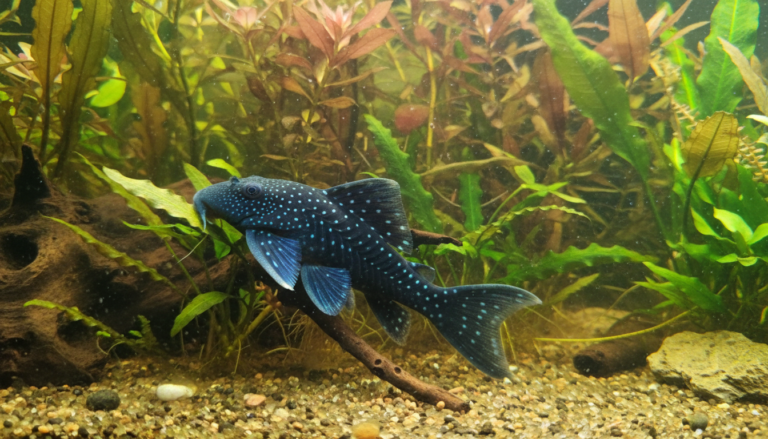
| Bristlenose pleco (Ancistrus sp.) | Yes | Needs its own cave; competes for algae wafers |
| Firemouth cichlid (Thorichthys meeki) | Yes, with space | Works in 250+ liters with separate territories |
| Keyhole cichlid (Cleithracara maronii) | Yes, with caution | Very peaceful; may be bullied during rainbow spawning |
| Convict cichlid (Amatitlania nigrofasciata) | No | Often wins disputes and dominates the bottom |
| Jack Dempsey (Rocio octofasciata) | No | Too large and aggressive for a rainbow pair |
| Neon tetras (Paracheirodon innesi) | No | Small enough to be eaten; prefer softer water |
| Cherry shrimp (Neocaridina davidi) | No | Treated as food |
| Angelfish (Pterophyllum scalare) | Not recommended | Different water needs; long fins get nipped by breeding pairs |
A useful comparison: the rainbow cichlid is often described alongside the firemouth as a “gateway” Central American. Unlike the firemouth, it grazes more than it hunts. It is less interested in small fish and much more interested in algae-covered stones.
Feeding the Rainbow Cichlid (Archocentrus multispinosus)
About 60–70% of the diet should be plant-based. Those tricuspid teeth are built for scraping algae, and a gut adapted to vegetable matter can develop bloating problems on too much protein.
A good weekly plan looks like this:
- Base food: a spirulina or vegetable-based sinking pellet or flake, once or twice daily.
- Vegetables 2–3 times a week: blanched zucchini slices, shelled peas, spinach or romaine lettuce. Weigh zucchini down with a plant anchor or stainless steel fork.
- Algae wafers in the evening, especially if you keep a pleco.
- Protein 1–2 times a week: frozen brine shrimp, mysis or daphnia.
- Occasional treats: frozen bloodworms, no more than once a week.
Feed only what disappears in about two minutes. Pull leftover vegetables after 12 hours, before they cloud the water.
Avoid beef heart and feeder fish. Both add fat and pathogen risk with no benefit for a mostly herbivorous cichlid. A diet dominated by high-protein cichlid pellets made for larger predatory fish can contribute to swelling and loss of appetite, the symptoms often grouped under “Malawi bloat.”
Pale color in a healthy fish often points to a diet that lacks carotenoids. Adding a pellet containing spirulina or astaxanthin usually brings back the yellow within 2–3 weeks.
Reproduction
Rainbow cichlids are open or cave substrate spawners with biparental care, and a settled pair can breed every 3–5 weeks. If you have a true pair, spawning rarely needs much encouragement.
Signs of an upcoming spawn include the black lower body, lip-locking and tail-slapping between partners. Both fish spend hours cleaning a flat stone or cave ceiling. The female’s ovipositor becomes visible a day or two before she lays.
A clutch typically contains 100–600 eggs, amber to yellowish in color, laid in neat rows. The male fertilizes each row as it is laid. At 26–27 °C the eggs hatch in about 3 days. The parents then move the wrigglers into pits dug in the sand, and the fry become free-swimming after another 5–7 days.
What to do once the fry swim:
- Feed newly hatched brine shrimp (Artemia nauplii) 3–4 times a day for the first two weeks.
- Offer finely crushed spirulina flake as a supplement from day 5 of free-swimming.
- Switch to a sponge filter or cover the intake.
- Remove egg-eaters like plecos and aggressive tankmates, or accept losses.
- Do 15–20% water changes every 2–3 days, since fry are sensitive to nitrate.
The parents guard the school for 4–6 weeks. When they begin cleaning a stone again, move the fry to a grow-out tank or the adults may chase them. Fry reach about 2.5 cm in 8–10 weeks.
A pair eating its first one or two clutches is common with young parents. Leave them alone. Most pairs get it right by the third spawn if the tank is quiet and dither fish are present.
FAQ
Are rainbow cichlids aggressive?
They are among the milder Central American cichlids. A pair defends its territory firmly during breeding but rarely kills tankmates in a tank of 200 liters or more with fast dither fish. They are still not safe with small tetras, shrimp or fin-heavy fish.
How big do rainbow cichlids get?
Males usually reach 10–13 cm and females 8–10 cm. They reach adult size in about 12–18 months on a good diet.
Can you keep a rainbow cichlid in a planted tank?
Yes, with hardy species. Anubias, Java fern and Cryptocoryne generally hold up, especially if tied to wood or rock. Expect uprooting near nest sites and occasional nibbling on softer plants.
How can you tell male and female rainbow cichlids apart?
Males are larger and have longer, pointed dorsal and anal fins. Females are smaller and rounder. During spawning, the female shows a blunt breeding tube, while the male’s tube is thinner and pointed.